AI Chatbot Development Cost in 2026: Key Factors, Price Ranges, and Budget Planning Tips
Key Highlights
- Businesses that launch AI chatbot projects without structured planning often face budget overruns and deployment delays, while Sigma Infosolutions helps define accurate scopes through AI engineering and cloud expertise.
- Poor chatbot scoping can increase rework costs and slow ROI, whereas Sigma enables faster deployments with scalable NLP, API integration, and cloud-native architectures.
- As conversational AI adoption accelerates globally, Sigma helps enterprises build secure, scalable, and production-ready AI chatbot solutions.
Businesses evaluating AI-driven automation frequently encounter a wide range in quoted prices, and understanding what drives AI chatbot development cost is the first step toward making a sound investment decision. A chatbot built for basic FAQ deflection carries an entirely different cost structure than a conversational AI system integrated with a CRM, order management platform, or lending workflow. Without a clear framework for scoping requirements, organizations risk either overspending on features they do not need or under-investing in infrastructure that cannot support production-scale usage. This blog outlines the primary cost factors, typical price ranges by project type, and how to approach budget planning for AI chatbot initiatives in 2026.
What Drives AI Chatbot Development Cost
Complexity of the Conversational Model
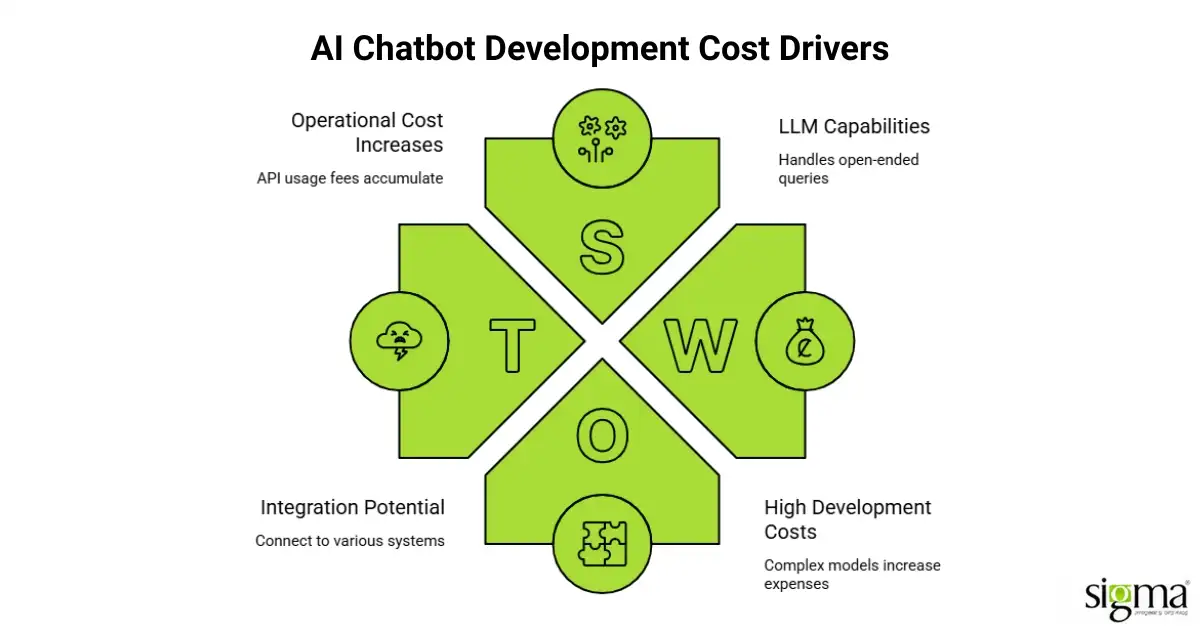
The most significant cost driver in any AI chatbot project is the complexity of the underlying conversational model. A rule-based chatbot that follows predefined decision trees requires far less engineering effort than a large language model (LLM)-powered assistant capable of handling open-ended queries, context retention across sessions, and dynamic responses. Organizations that require multi-turn dialogue, intent classification with high accuracy, or domain-specific fine-tuning should expect development costs to increase substantially compared to simpler implementations.
The choice of an AI model also affects ongoing operational costs. Using third-party APIs such as OpenAI’s GPT-4 or Azure OpenAI introduces per-token usage fees that accumulate with volume, while self-hosted open-source models reduce per-query costs but require more upfront infrastructure investment. Both approaches carry distinct trade-offs for total cost of ownership, and the right choice depends heavily on expected query volume and data privacy requirements.
Integration Depth and Data Sources
A chatbot that operates in isolation, answering static questions from a knowledge base, costs significantly less to build than one that must connect in real time to CRM systems, product catalogs, payment platforms, or internal databases. Each integration point introduces additional development work for API design, authentication handling, error management, and data transformation. For businesses in regulated industries such as financial services or healthcare, integration work also includes compliance validation, which adds both time and cost to the project scope.
Platform and Deployment Environment
The deployment location of the chatbot impacts both the complexity of the build and the hosting expenses. A chatbot embedded in a website via a JavaScript widget is simpler to deploy than one that must operate across mobile applications, WhatsApp, Slack, and internal portals simultaneously. Multi-channel deployments require abstraction layers that decouple the conversational logic from the delivery channel, which adds architectural complexity and increases the engineering effort required for testing and maintenance.
CTA: Build scalable, secure, and intelligent conversational AI solutions with Sigma Infosolutions’s Artificial Intelligence Development Services, designed to streamline automation, optimize customer experiences, and accelerate business growth.
AI Chatbot Pricing: Typical Ranges by Project Type
The table below provides a structured overview of AI chatbot pricing ranges based on project type, helping organizations align budget planning for AI initiatives with realistic market expectations.
Chatbot Type | Typical Price Range (USD) | Development Timeline | Key Cost Drivers |
| Rule-Based / FAQ Bot | $5,000 to $20,000 | 4 to 8 weeks | Content mapping, UI integration |
| NLP-Powered Intent Bot | $20,000 to $60,000 | 8 to 16 weeks | NLP training, API connections |
| LLM-Integrated Assistant | $60,000 to $150,000 | 16 to 24 weeks | Model selection, fine-tuning, security |
| Enterprise Multi-Channel Bot | $150,000 to $400,000+ | 6 to 12 months | System integrations, compliance, scale |
| Ongoing Maintenance (Annual) | 15% to 20% of the build cost | Continuous | Retraining, monitoring, updates |
These ranges assume US-based or hybrid delivery models. Offshore-augmented development teams, particularly those operating from Tier-1 Indian engineering centers, can reduce build costs by 30% to 50% for equivalent technical scope without reducing output quality.
Read our success story: From Fragmented Systems to AI-Powered District Operations Intelligence
Budget Planning for AI Chatbot Projects
Defining Scope Before Soliciting Quotes
The most common reason chatbot projects exceed their initial budgets is that the scope was not defined with sufficient precision before development began. Organizations frequently request quotes based on high-level descriptions such as “a chatbot for customer support,” which allows vendors to make assumptions that may not reflect actual requirements. A structured requirements document should specify the number of intents, the data sources the chatbot must access, the channels it must support, the languages it must handle, and the volume of concurrent users it must serve.
Establishing these parameters upfront allows vendors to provide accurate fixed-price or capped time-and-materials estimates rather than open-ended quotes that expand during development. It also allows the organization to make meaningful comparisons across vendor responses, since all parties are pricing against the same specification.
Accounting for Post-Launch Costs
AI chatbot pricing discussions frequently focus on the initial build cost and underestimate what it costs to maintain and improve a chatbot after it goes live. Language models require periodic retraining as user behavior changes and new query types emerge. Integrations break when upstream systems are updated. Conversation logs must be reviewed for failure patterns and used to improve intent recognition accuracy over time. Organizations that do not budget for these ongoing activities typically see chatbot performance degrade within six to twelve months of launch.
A realistic annual maintenance budget should account for model updates, infrastructure scaling, security patching, and, at a minimum, one major feature enhancement cycle per year. For most mid-market deployments, this translates to 15% to 20% of the original build cost per year, which should be included in any total cost of ownership calculation.
Also, read the blog : How to Build an AI Chatbot: A Step-by-Step Guide
How Sigma Infosolutions Approaches AI Chatbot Development
Building an enterprise AI chatbot requires more than connecting a language model to a user interface. Organizations need a structured engineering approach that aligns conversational design, infrastructure scalability, integration architecture, and long-term operational planning with real business goals. Without that foundation, chatbot projects often face cost overruns, inconsistent user experiences, and performance limitations after deployment.
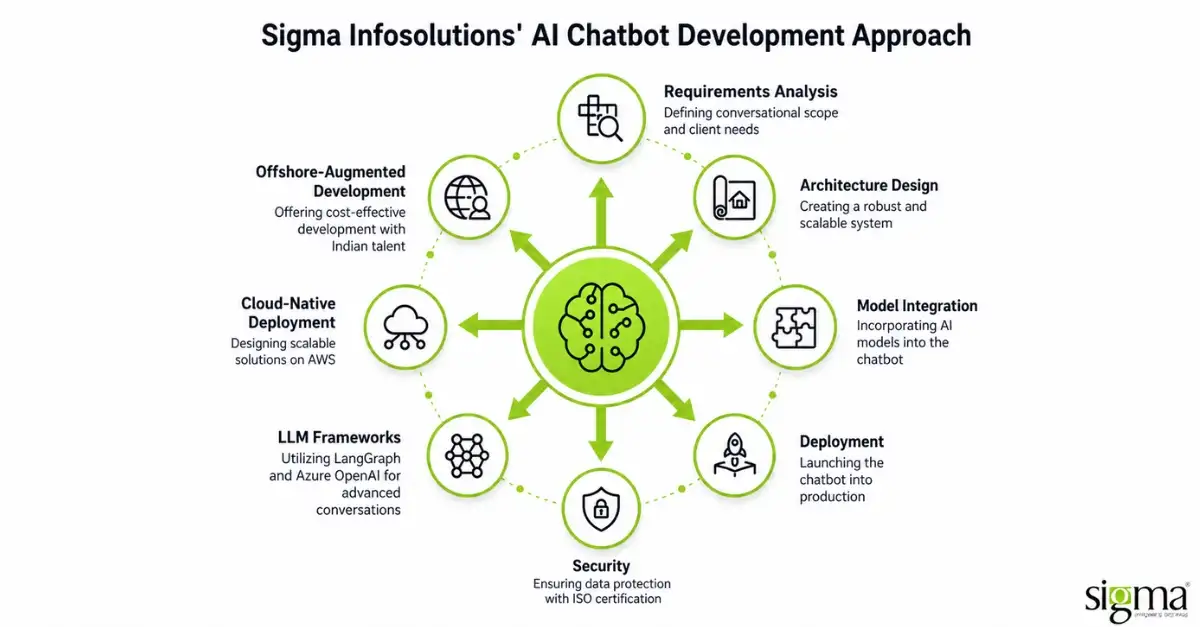
Sigma Infosolutions approaches AI chatbot development through a custom software engineering framework designed to help businesses deploy scalable, secure, and production-ready conversational AI systems. From project scoping and architecture planning to LLM integration and cloud deployment, Sigma focuses on delivering AI chatbot solutions that balance innovation, operational efficiency, and predictable development costs.
Structured Discovery and Scope Definition
Sigma begins every AI chatbot engagement with detailed requirements analysis to clearly define conversational workflows, user intents, integration dependencies, and infrastructure needs. This upfront scoping process helps organizations avoid uncontrolled feature expansion, inaccurate pricing estimates, and unnecessary redevelopment later in the project lifecycle.
Enterprise-Grade Architecture and Security
For businesses handling sensitive customer or financial information, security and compliance are foundational requirements. Sigma’s delivery framework is backed by ISO/IEC 27001:2022-certified information security practices, enabling the team to build chatbot systems with secure data handling, controlled access management, and enterprise-ready deployment standards.
LLM Integration and Stateful Conversational Design
For advanced conversational AI systems, Sigma engineers work with technologies such as LangGraph and Azure OpenAI to develop chatbots capable of multi-turn conversations, contextual memory retention, and dynamic response generation. These capabilities are especially important for industries such as financial services, eCommerce, and enterprise operations where conversations often involve complex workflows and personalized interactions.
Cloud-Native Deployment and Scalability
As an AWS Select Technology Partner, Sigma designs cloud-native chatbot infrastructures optimized for scalability, reliability, and production-grade performance. This approach enables businesses to support growing user volumes, multi-channel deployments, and evolving AI workloads without compromising system stability or response speed.
Cost-Efficient Offshore-Augmented Delivery
Sigma combines senior architectural oversight and strategic account management with offshore-augmented engineering delivery to help businesses optimize AI chatbot development costs. This model allows organizations to access experienced AI engineering talent, maintain project quality, and stay within defined budget expectations without sacrificing scalability or long-term maintainability.
Conclusion
AI chatbot development cost in 2026 depends heavily on conversational complexity, integration depth, deployment architecture, and long-term maintenance requirements. Businesses that define project scope clearly, plan for operational scalability, and align technology choices with business goals are far more likely to control costs and achieve measurable ROI from conversational AI initiatives.
As enterprise adoption of AI accelerates, organizations need engineering partners that can balance innovation, security, scalability, and budget predictability. Sigma Infosolutions helps businesses design and deploy intelligent chatbot solutions with structured delivery frameworks, cloud-native architectures, and enterprise-grade AI engineering expertise tailored for production-scale growth.
Frequently Asked Questions
Q: What is the average AI chatbot development cost for a mid-sized business?
A: For a mid-sized business requiring NLP-based intent handling and one or two system integrations, development costs typically range from $20,000 to $60,000. The final figure depends on the number of intents, data sources, and channels the chatbot must support.
Q: How does chatbot pricing differ between rule-based and LLM-powered bots?
A: Rule-based chatbot pricing typically starts around $5,000 and is suitable for structured, predictable query types. LLM-powered bots begin at $60,000 or more because they require model selection, prompt engineering, fine-tuning, and more complex infrastructure to operate reliably at scale.
Q: What should be included in budget planning for AI chatbot projects?
A: Budget planning for AI should include the initial build cost, integration development, testing, deployment infrastructure, and an annual maintenance allocation of 15% to 20% of the build cost. Excluding post-launch costs is one of the most common reasons chatbot projects exceed their total expected investment.
Q: Can offshore development reduce AI chatbot development cost without reducing quality?
A: Yes, hybrid delivery models that combine onshore project management with offshore engineering execution can reduce development costs by 30% to 50% for equivalent technical scope. The key is ensuring that the offshore team has senior architects involved in design decisions, not just execution.
Q: How long does it take to develop an AI chatbot?
A: Simple rule-based or FAQ bots can be delivered in four to eight weeks. LLM-integrated assistants with multiple system integrations typically require 16 to 24 weeks from requirements finalization to production deployment.
Q: Does AI chatbot pricing include ongoing model retraining?
A: Most initial project quotes do not include ongoing retraining, which is typically scoped as a separate managed services engagement. Organizations should clarify this with vendors during the proposal stage to avoid gaps in their support coverage after launch.
Q: What factors most affect AI chatbot pricing for enterprise deployments?
A: The primary factors are the number and complexity of system integrations, the need for multi-channel support, compliance requirements in regulated industries, and whether the chatbot requires custom model fine-tuning or can operate on a general-purpose LLM with prompt engineering alone.
Q: How does Sigma Infosolutions handle security in AI chatbot development?
A: Sigma holds ISO/IEC 27001:2022 certification for information security management, which governs how the team handles sensitive data during development and deployment. For chatbots processing financial or personally identifiable information, Sigma applies data classification controls and access management protocols aligned with this standard.