Application Development for Business Goals: How to Align Your App Roadmap with Revenue Outcomes

Key Takeaways:
- Most application teams ship features faster but struggle to show how those releases impact revenue or costs. Sigma aligns every development effort to measurable business outcomes, turning engineering velocity into financial impact.
- Engineering and finance often operate in silos, making it difficult to justify development budgets with clear ROI. Sigma bridges this divide through a discovery-led framework that connects CTO priorities with CFO expectations, ensuring every sprint is tied to business value.
- Legacy systems and disconnected workflows create operational drag and limit growth opportunities. Sigma modernizes and re-architects applications to reduce costs, unlock new revenue channels, and transform software into a scalable profit driver.
Most application roadmaps look impressive during a slide presentation. They are packed with shiny buttons and sleek interfaces. But everything changes the moment a CFO asks: “What actual revenue does this generate?” In today’s market, moving fast and breaking things is a luxury no one can afford. The truth is that feature velocity does not equal business impact. You can ship code every hour, but if those updates don’t move the needle on your profit and loss statement, you are just spinning your wheels.
To win in today’s competitive world, leaders must stop seeing engineering as a cost center and start viewing it as a primary revenue driver. This requires a shift toward Enterprise Product Engineering Services that treat every line of code as a financial investment and high-level Custom Software Development Services to ensure that technical decisions are tied to financial outcomes from day one. This blog will show you how to stop building for building’s sake and turn your roadmap into a powerful financial blueprint.
How to Align App Development with Business Goals (Before You Write Code)
Most application roadmaps fail long before development begins. Not because of poor engineering, but because the wrong problems are prioritized. This is where most organizations go wrong. They jump straight from idea to execution without validating whether the roadmap is tied to measurable business outcomes.
At Sigma, application development doesn’t start with features or architecture. It starts with a structured discovery model designed to align business goals with technical decisions before a single line of code is written.
This is how you avoid building the wrong roadmap in the first place.
The Sigma Discovery Model focuses on three critical steps:
1. Define Measurable Business Outcomes
Instead of vague goals, we establish clear financial targets, such as reducing operational costs, increasing conversion rates, or improving customer retention.
2. Map Outcomes to Technical Initiatives
Each business goal is translated into specific application capabilities. Every feature is treated as a hypothesis tied to a measurable impact.
3. Prioritize Based on ROI, Not Effort Alone
Using impact-based scoring, we rank initiatives based on potential return, implementation complexity, and confidence levels, ensuring that development focuses on what drives real business value.
The result is not just a roadmap, but a financial blueprint where every engineering decision is directly connected to revenue outcomes, cost efficiency, or productivity gains.
The Hidden Cost of Feature-First Application Development Roadmaps
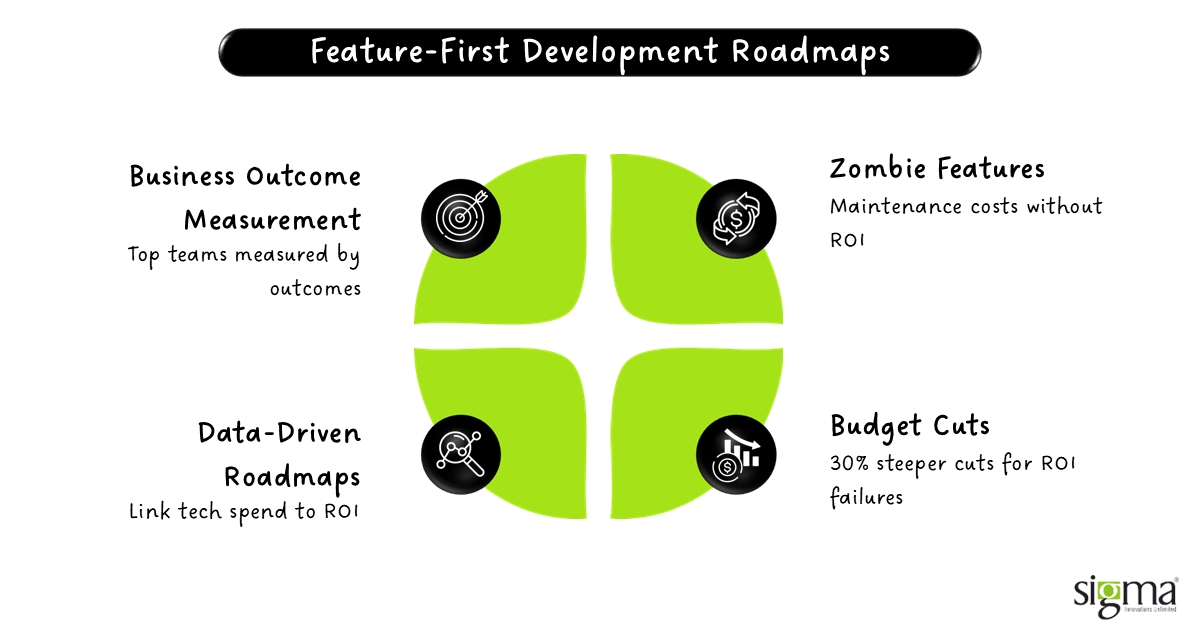
We need to talk about “Zombie Features.” These are the parts of your app that were built with excitement but now just sit there, sucking up maintenance costs without ever helping the bottom line. When you focus only on application development without a revenue lens, you create a graveyard of wasted engineering hours. In fact, recent projections suggest that by the end of this year, companies failing to link tech spend to clear ROI will face 30% steeper budget cuts compared to those using data-driven roadmaps.
Wasting your team’s bandwidth on things that don’t matter isn’t just a mistake, but a liability. While your competitors are focusing on business application development that slashes customer churn, you might be adding tech debt that provides zero return. If your team is shipping features every quarter but can’t explain how they affect Monthly Recurring Revenue (MRR) or Customer Lifetime Value (CLTV), your software development services are failing you. The solution isn’t to work harder or prioritize better, but requires rethinking how application investments are evaluated and adopt a model where every technical requirement is born from a business goal.
According to recent industry insights from leading consulting firms, top-performing engineering teams are now measured by business outcomes rather than just output.
How to Build an Application Roadmap That Drives Revenue
Building an application roadmap that drives revenue requires moving beyond static feature lists and toward outcome-driven planning. A high-impact roadmap is structured around business priorities such as revenue expansion, cost efficiency, customer retention, and operational productivity.
Start by identifying key revenue levers within your business. Then map application initiatives to these levers, for example, introducing self-service capabilities to reduce support costs or enabling new digital channels to unlock additional revenue streams.
Modern application roadmap planning also relies on continuous validation. Instead of committing to long-term feature plans, organizations should adopt iterative roadmaps that allow for rapid experimentation and course correction based on real performance data.
When done right, an application roadmap becomes a financial strategy document—guiding engineering investments toward measurable business outcomes.
The Shift from Feature Roadmaps to Financial Blueprints
The era of building for the sake of building is over, and now we are entering the age of the “Revenue-First Engineering Mandate.” This isn’t just a fancy phrase, but a total shift in how leaders approach application development. Instead of asking your team, “What are we building this month?” you must start asking, “What business outcome are we buying?” If you cannot name the financial benefit, you shouldn’t be writing the code.
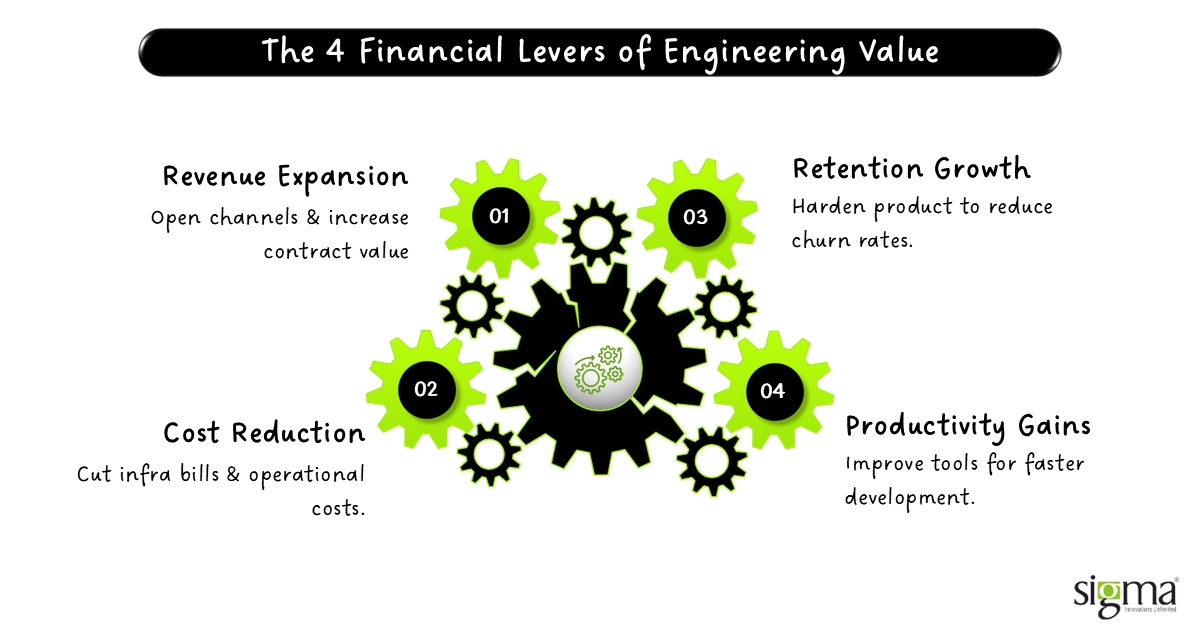
To make this work, every project should fall into one of four buckets:
- Cost Reduction (lowering bills),
- Revenue Expansion (opening new sales channels),
- Retention Growth (keeping customers longer), or
- Productivity Gains (making the team faster).
This is the heart of a modern enterprise digital transformation strategy. Every single item in your product backlog must map directly to one of these financial levers, or it simply doesn’t make the cut. To actually put this into practice, you need a structured way to connect your big business dreams to your daily technical tasks.
What an ROI-Aligned Application Roadmap Looks Like
An ROI-aligned application roadmap doesn’t start with features—it starts with business goals and works backward into technical decisions. Every initiative is explicitly tied to a measurable outcome, ensuring that engineering effort translates into financial impact.
Here’s what that looks like in practice:
| Business Goal | Application Feature | KPI | Expected Impact |
| Reduce operational costs | Self-service customer portal | Support ticket volume, cost per ticket | 20–30% reduction in support costs |
| Increase revenue | Subscription billing & pricing engine | Monthly Recurring Revenue (MRR), conversion rate | 10–15% uplift in recurring revenue |
| Improve customer retention | Personalized dashboards & alerts | Churn rate, user engagement | 15–25% reduction in churn |
| Improve internal productivity | Workflow automation & system integration | Task completion time, employee productivity | 25–40% efficiency gain |
This structure forces clarity at every stage of application roadmap planning. Instead of asking “What should we build next?”, teams ask “What business outcome are we driving, and how will we measure success?”
In this model:
- Features are not outputs, but investments tied to returns
- Roadmaps are not static plans, but financial decision frameworks
- Engineering becomes accountable to business performance, not just delivery timelines
This is the shift that separates high-performing engineering organizations from those stuck maintaining features with no measurable impact.
Also, read the blog – Embedded Software Engineering: The Hidden Layer Powering Modern Connected Products
Sigma’s Business-Outcome Alignment Framework
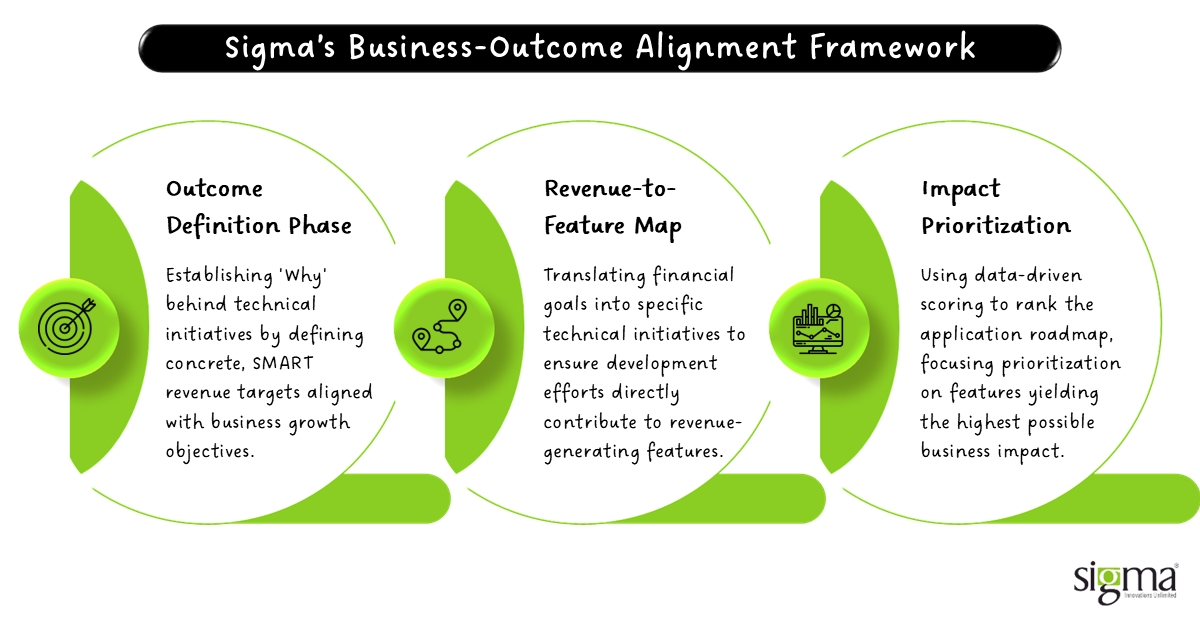
To turn a vision into a high-yield asset, you need a disciplined process. At Sigma Infosolutions, we approach application development as a financial planning exercise, not just an engineering activity , but use a three-phase approach that bridges the gap between your balance sheet and your codebase. This is the cornerstone of our custom application development philosophy.
Phase 1: Outcome Definition
Before we talk about languages or frameworks, we define SMART revenue goals. We look at the “why” behind the build. For example, are we aiming for a 15% increase in customer retention or a 25% drop in operational costs? We segment your revenue sources by geography or product line to ensure the business requirements for software projects are laser-focused on where the money actually comes from.
Phase 2: Revenue-to-Feature Mapping
Once the goals are set, we translate them into technical initiatives. If the goal is retention, the initiative might be a real-time personalization engine. If the goal is new revenue, we might build a robust subscription layer or API monetization tools. We treat features as hypotheses for revenue impact. This ensures that custom software development services aren’t just creating tools, but building financial engines.
Phase 3: Impact-Based Prioritization
Finally, we use a structured application roadmap planning model. Using weighted scoring, we rank tasks based on revenue impact, effort, and our confidence in the result. Sigma maps technical architecture decisions to financial KPIs before a single line of code is written. This ensures your business process automation software or platform is built for maximum ROI.
This is where most vendors stop at planning, but execution discipline is what determines ROI.
How to Align App Development with Business Goals
Aligning application development with business goals starts by shifting the conversation from features to outcomes. Instead of asking what to build, teams must define what success looks like in measurable terms—such as increased revenue, reduced operational costs, improved retention, or faster time-to-market.
This requires a structured approach where business stakeholders and engineering leaders work together to define clear KPIs before development begins. Each application initiative should directly map to a specific business objective, ensuring that development efforts are tied to financial impact.
The most effective organizations operationalize this alignment through discovery-led planning, where technical requirements are derived from business priorities—not the other way around. This ensures that application development becomes a strategic growth lever rather than a cost center.
Also, read the blog: Custom App Development Services: What to Expect in 2026
The Sigma Discovery Model for Custom Application Development
At Sigma, we believe that the most expensive mistake a company can make is building the wrong thing perfectly. This is why our application development consulting starts long before we open a code editor. Our core differentiator is the Sigma Discovery Model. We don’t just “gather requirements“, but also perform financial modeling for engineering decisions.
Our process brings CTOs and CFOs into the same room for stakeholder workshops. We move away from simple feature lists and focus on KPI-first architecture design. During this phase, we identify your primary revenue levers, high-cost centers, and operational bottlenecks. We then build an outcome-based backlog where every technical task is a direct response to a business challenge.
The final output isn’t just a plan, but an ROI-backed roadmap with measurable success metrics for every initiative. This is how engineering teams secure budget approval faster because they walk into the boardroom with hard numbers instead of hopeful assumptions. By treating discovery as a strategic software modernization consulting exercise, we ensure your investment is protected from day one.
Mapping Applications to 4 Revenue Outcomes
To gain a competitive advantage, leaders must shift their language. You aren’t “building feature X“; you are “increasing conversion by 5%.” Use this playbook to align your business application development with the four pillars of profit:
- Reduced Operational Cost: Look for manual workflows that slow you down. By building self-service portals, you can slash support tickets and labor costs. This is the essence of business process automation software.
- New Revenue Channels: Think beyond your current product. Can you open up APIs or build an integration marketplace? Turning your product into an ecosystem creates new revenue streams that didn’t exist before.
- Customer Retention Lift: Use data-driven engagement features to keep users hooked. Predictive insight dashboards that show your customers the value they receive can drastically reduce churn rates.
- Internal Productivity Gains: Centralized systems and better data flows mean faster decision-making. When your team spends less time fighting tools and more time building, your time-to-market drops, giving you a massive edge.
By focusing on these software development ROI metrics, you turn your app into a tool that actually pays for itself.
How to Prioritize Application Features Based on ROI
Prioritizing application features based on ROI requires treating every feature as a business hypothesis. Instead of relying solely on effort or stakeholder preference, organizations must evaluate features based on their expected financial impact.
A practical approach is to score each initiative across three dimensions: potential business impact, implementation effort, and confidence in expected outcomes. Features that deliver high impact with reasonable effort should be prioritized, while low-impact initiatives should be deprioritized regardless of how easy they are to build.
This impact-based prioritization ensures that development resources are consistently allocated to initiatives that drive measurable value, whether through increased revenue, reduced costs, or improved efficiency.
By embedding ROI into prioritization decisions, application development becomes more predictable, accountable, and aligned with executive expectations.
How Modern Architectures Enable Revenue Alignment
To build for the bottom line, your tech stack must be as flexible as your strategy. In today’s competitive world, enterprise application development relies on cloud-native architectures and API-first ecosystems to stay ahead. These are the tools that allow for faster experimentation. When you can launch a pilot feature in days rather than months, you get faster revenue validation. Legacy systems often fail because they are too rigid to adapt to shifting business application development needs. At Sigma, we specialize in building scalable, data-driven systems that support continuous ROI tracking. By using modern frameworks, we ensure your software isn’t just a static tool, but a living asset that can pivot whenever a new market opportunity appears.
Proving ROI to the CFO and Measuring What Matters
If you want to keep your budget, you have to speak the language of the C-suite. This means moving away from “lines of code” and focusing on software development ROI metrics like Monthly Recurring Revenue (MRR), Customer Lifetime Value (CLTV), and Churn Rate. Every release in your application modernization strategy must tie back to at least one of these KPIs. We recommend a quarterly roadmap recalibration to ensure your goals still align with market reality. Remember, if you can’t measure it, you can’t justify it. Proving impact is the only way to turn a skeptical CFO into your biggest engineering advocate.
Common Pitfalls That Break Alignment
Even the best teams can stumble. The most common trap is “feature creep,” where you add bells and whistles that have no business linkage. Another huge mistake is treating your application roadmap planning as a static document that never changes. If you aren’t involving the CFO in major tech decisions or if you are measuring “features shipped” instead of actual outcomes, you are at risk. Misalignment doesn’t usually fail loudly with a big crash, but erodes your ROI silently until the budget disappears.
Read our success story – Automating Ticket Resolution with AI-Powered Resolvify++
Final Thoughts
The era of “building for building’s sake” is officially over. To thrive, engineering departments must own their revenue impact. Your roadmap should no longer be a wishlist of cool tech, but must be a financial strategy. As we look toward the future, the companies that win will be the ones where every line of code has a clear business case. By shifting your focus from output to outcomes, you transform your team from a cost center into a primary engine for growth.
So, stop gambling with your development budget. Sigma Infosolutions is your ROI-driven development partner, focusing on a discovery-led approach that ensures every sprint delivers value. Whether you need Custom Software Development Services or a complete enterprise digital transformation strategy, we are here to help you scale.
Frequently Asked Questions (FAQs)
1. How do I align app development with business goals?
Start by defining the “Why” before the “How.” Instead of listing features, list desired outcomes like “Reducing Churn by 10%” or “Automating Onboarding.” Every technical requirement should be a direct response to a specific business KPI.
2. What is the best way to build an application roadmap?
Move away from static documents. Build a dynamic roadmap centered on four buckets: Cost Reduction, Revenue Expansion, Retention, and Productivity. Use a weighted scoring model to rank tasks based on financial impact versus engineering effort.
3. How can software help reduce operational costs?
Focus on “Business Process Automation.” Identify manual, repetitive workflows like ticket resolution or data entry and build self-service portals or AI-driven tools. This slashes labor costs and frees your team for high-value work.
4. How should I prioritize application features based on ROI?
Treat every feature as a revenue hypothesis. Use Sigma’s “Impact-Based Prioritization” to score features based on our confidence in their financial return. If you can’t name the financial lever a feature pulls, it stays in the backlog.