Difference between Artificial Intelligence and Machine Learning
Key Takeaways:
- AI is the map, ML is the engine: Know the difference, or risk wandering in the data wilderness. Sigma turns strategy into a smooth, profitable journey.
- Data without action is like a library with closed books: ML unlocks insights from AI’s vision. Enterprises can use predictive analytics and intelligent automation to read the story of their business.
- Integration is the secret sauce: AI ambition alone won’t cook results. Sigma blends BI & Analytics, Product Engineering, and AI/ML solutions into a recipe for real-world success.
Every enterprise today talks about Artificial Intelligence (AI), but most of what they’re actually using is Machine Learning (ML). It’s a line that even tech leaders blur. The truth is, while AI and ML are connected, they’re not the same. And for businesses trying to build smart business solutions, that difference isn’t just a matter of definition; it’s the line between strategy and execution.
Think of AI as the vision, the broader goal of simulating human intelligence so systems can think, reason, and make decisions. ML, on the other hand, is the engine that powers that vision. The practical way machines learn from data, predict outcomes, and automate tasks. For enterprises, understanding this difference is what separates those who talk about innovation from those who actually achieve it.
At Sigma, we view AI as the overarching framework that shapes business strategy and ML as the workhorse that translates that strategy into results through predictive analytics, intelligent automation services, and hyper-personalization.
In this blog, we’ll move past the textbook talk and decode what the difference between AI and ML truly means for enterprises. More importantly, we’ll explore how Sigma Infosolutions helps companies translate the potential of AI and ML development services into measurable business performance, making data work smarter, not just harder.
AI vs. ML from a Business Lens (Understanding the Core Difference)
To many, Artificial Intelligence (AI) and Machine Learning (ML) sound like two sides of the same coin. However, for enterprises building smart business solutions, understanding how they differ is crucial to driving results that matter.
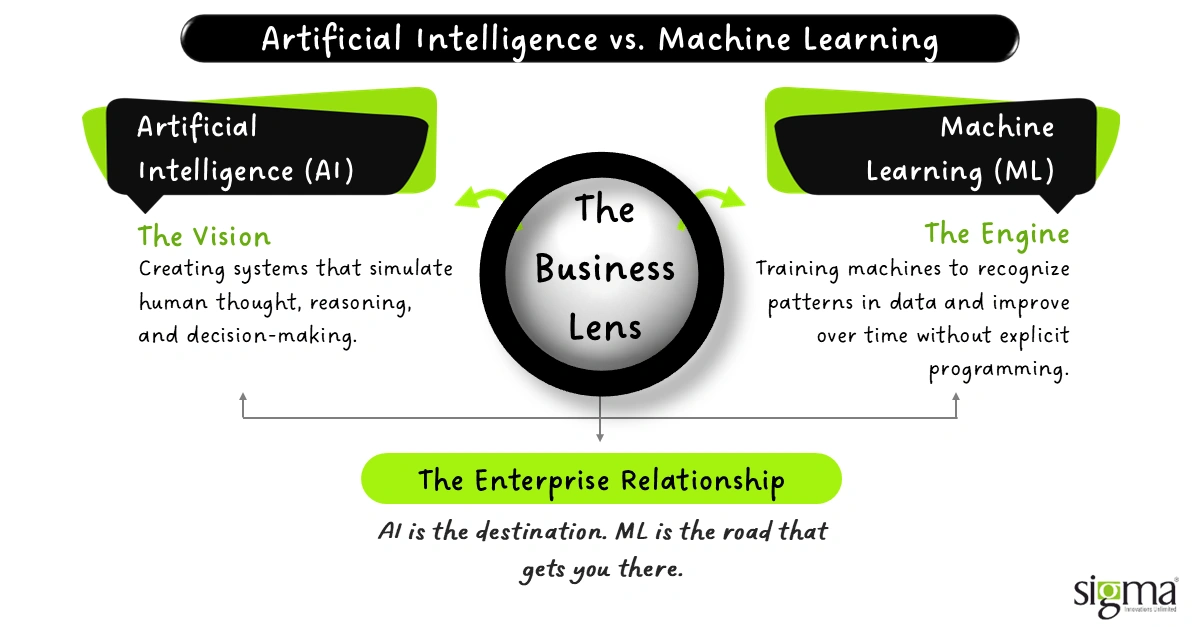
AI (Artificial Intelligence) is about creating systems that can think, reason, and make decisions, simulating the way humans process information. It’s the science behind making machines intelligent enough to solve complex business problems, from fraud detection to predictive forecasting.
ML (Machine Learning), on the other hand, is the hands-on approach. It’s the process of training machines to recognize patterns in data and improve over time without being explicitly programmed. ML makes AI practical by turning vast amounts of data into actionable insights that power automation and prediction.
For enterprises, the relationship between AI and ML is simple:
- AI is the strategic umbrella. It defines the “what” and “why.”
- ML is the operational engine. It delivers the “how.”
Take eCommerce as an example. AI shapes the goal: offering each customer a personalized shopping experience. ML powers the recommendation algorithms that predict what the customer will buy next. The same logic applies across industries, from intelligent automation services in fintech to business intelligence and analytics in product engineering.
“In one line: AI is the destination. ML is the road that gets you there.”
By understanding this distinction, enterprises can align vision with execution to bridge innovation strategy with measurable outcomes through AI and ML development services that turn data into real business value.
Why the Difference Matters for Enterprises
For most business leaders, the real challenge isn’t defining Artificial Intelligence (AI) or Machine Learning (ML), it’s using them the right way. When enterprises treat AI and ML as interchangeable, they often set themselves up for strategy gaps and missed ROI opportunities.
Many organizations proudly announce “AI-driven transformations,” but behind the scenes, they lack the data infrastructure, model-readiness, or analytics maturity needed to make those ambitions work. The result? Projects that sound futuristic on paper but fail to deliver measurable business value.
That’s where understanding the difference between AI and ML becomes crucial.
- AI represents the strategic vision; it’s about setting the goal of building systems that mimic human intelligence and support decision-making.
- ML represents the operational path; the step-by-step process of learning from data to automate tasks, optimize performance, and generate predictions.
Enterprises that adopt ML-first strategies tend to see tangible ROI faster, because they focus on measurable outcomes like automation, forecasting accuracy, and personalization instead of abstract innovation goals.
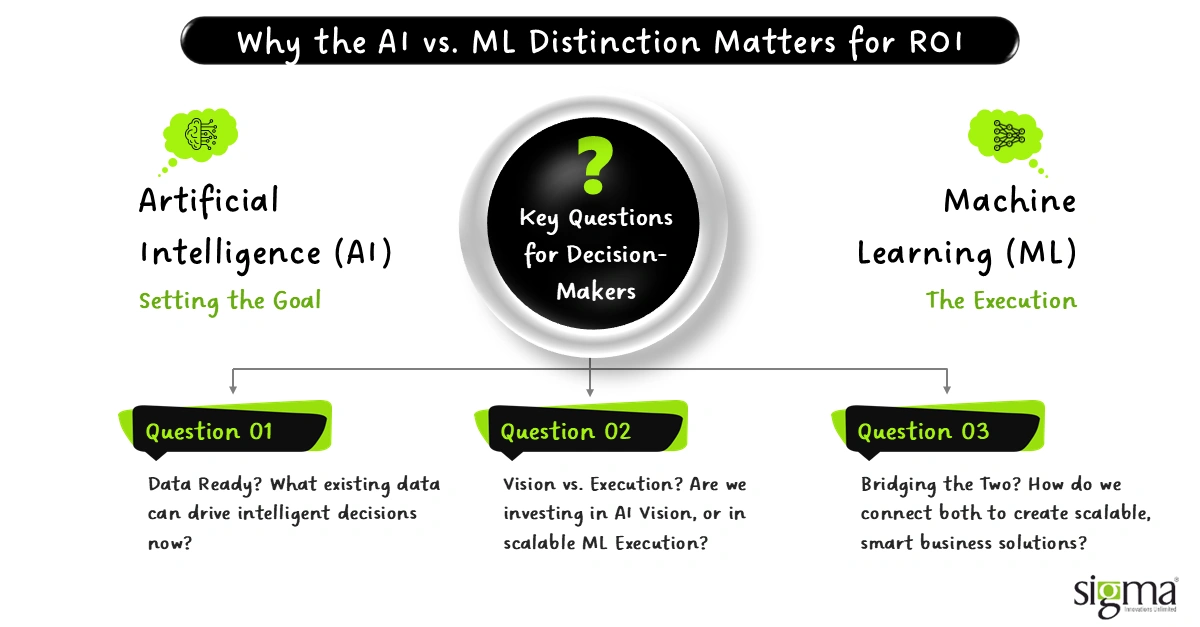
Here are a few questions every technology decision-maker should be asking:
- What data do we already have that can drive intelligent decisions?
- Are we investing in AI vision, or in ML execution?
- How do we bridge the two to create scalable, smart business solutions?
This is where Sigma Infosolutions becomes the bridge. We help enterprises connect AI strategy with ML practicality, combining the foresight of AI with the executional power of ML.
Through our BI & analytical development services, AI ML solutions, and Product Engineering Services, we enable organizations to:
- Build data-driven business solutions tailored to their goals.
- Achieve predictive analytics and forecasting accuracy that fuels growth.
- Implement intelligent automation services that cut operational friction.
By aligning AI’s vision with ML’s execution, Sigma helps enterprises turn big ideas into real-world business performance. Proving that success in the age of intelligence isn’t about choosing between AI and ML, but knowing how to make them work together.
Also Read: Sharpen your Security using AWS Security Hub
How AI and ML Work Together (From Concept to Capability)
When it comes to building smart business solutions, Artificial Intelligence (AI) and Machine Learning (ML) aren’t rivals; they’re teammates. Think of them as two gears in the same engine: one sets the direction, the other keeps things moving.
At a high level:
- AI is the Vision – It defines what the system should be capable of doing, like reasoning, understanding, and acting intelligently.
- ML is the Learning Mechanism – It’s how the system learns those capabilities by recognizing patterns, improving over time, and turning data into insight.
- Data Analytics is the Foundation – It provides the raw material both AI and ML depend on. Without structured, accurate, and actionable data, even the smartest models can’t deliver value.
In short, AI tells the “what,” ML handles the “how,” and data analytics fuels the “why.”
Here’s a simple, real-world comparison:
- AI goal: “Build a self-learning eCommerce recommendation engine that enhances every customer’s journey.”
- ML execution: “Train the algorithm using purchase history, browsing data, and transaction patterns to predict what each shopper might want next.”
The same logic applies across industries:
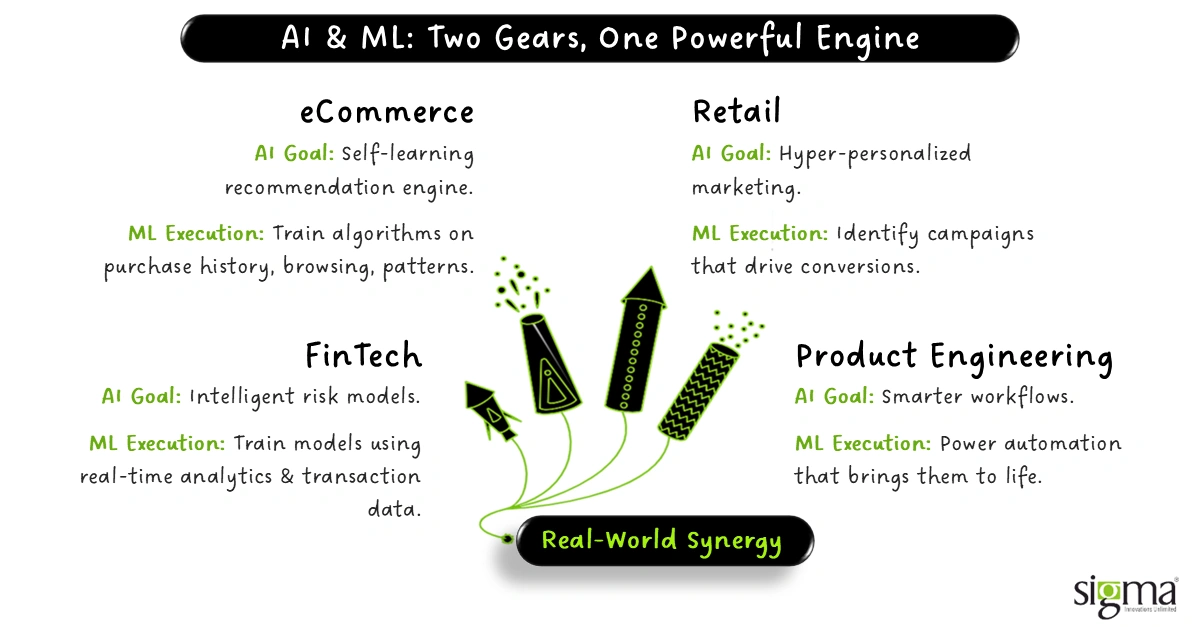
- In fintech, AI defines intelligent risk models; ML trains those models using real-time analytics and transaction data.
- In retail, AI sets the vision for hyper-personalized marketing; ML identifies which campaigns drive conversions.
- In product engineering, AI envisions smarter workflows; ML powers automation that brings them to life.
At Sigma Infosolutions, we bring this synergy to life through an integrated approach that blends Business Intelligence & Analytics services, AI and ML development services, and Product Engineering Services. By connecting data analytics, intelligent automation services, and custom development services, we help enterprises:
- Convert raw data into AI-driven solutions that guide smarter decisions.
- Build real-time analytics and data streaming systems for dynamic business insight.
- Implement AI ML solutions that scale with their enterprise architecture.
In every project, Sigma acts as the architect that aligns concept with capability, ensuring AI’s vision and ML’s execution move in sync to deliver measurable, long-term business value.
Want to know how AI and ML are powering supply chain optimization? Read the full blog
Real-World Impact (AI and ML in Action Across Industries)
Understanding the difference between AI and ML isn’t just an academic exercise; it’s what separates vision from real business impact. Across verticals like Fintech, eCommerce, and Product Engineering, the collaboration of AI and ML is transforming how enterprises operate, make decisions, and create value.
Fintech (From Smarter Credit Scoring to Real-Time Risk Analytics)
In Fintech, where every decision involves trust, precision, and timing, AI and ML development services are redefining efficiency.
- Predictive credit scoring models now analyze thousands of variables, not just credit history, to identify lending potential.
- Fraud detection systems learn from real-time data streams to catch anomalies before they become costly losses.
- Portfolio optimization tools use AI-driven analytics to balance risk and return dynamically.
With ML, lenders gain sharper underwriting accuracy. With AI, they make smarter, faster decisions at scale.
At Sigma Infosolutions, our Fintech experience includes building AI-enabled loan origination systems and risk analytics platforms that automate manual checks, reduce approval times, and improve credit quality.
See how we helped a US-based lender make faster, smarter lending decisions with BI-powered analytics. Read the full case study
eCommerce & Retail (Personalization That Sells)
In eCommerce, data is the new storefront, and AI & ML solutions power everything from browsing to buying.
- Personalized recommendations use ML algorithms to understand each customer’s preferences in real time.
- Inventory forecasting ensures shelves are stocked for demand, not guesswork.
- Dynamic pricing helps brands stay competitive and profitable, adjusting prices automatically based on market signals.
AI sets the goal by creating intuitive, personalized shopping experiences. ML delivers it by analyzing clickstream data, purchase history, and user behavior.
Sigma brings this to life through Magento + AI integrations, intelligent search engines, and personalization systems that convert browsing into buying.
Explore how our AI-driven eCommerce development and BI analytics services improve engagement and sales. Read the full case study
Product Engineering (Designing Operations with Intelligence)
Modern enterprises don’t just build products; they engineer intelligence into every process. That’s where AI and ML development services in the USA help unlock the next level of innovation.
- Intelligent automation streamlines repetitive tasks, freeing human talent for creativity and strategy.
- Anomaly detection identifies system glitches or performance bottlenecks before they impact operations.
- Smart product design uses business intelligence and analytics to fine-tune user experiences based on feedback and behavior data.
Sigma’s Product Engineering Services combine data analytics, .NET development services, and AI-driven solutions to create platforms that think, learn, and evolve.
See how we used AI-powered insights to transform resource management and operational efficiency. Read the full case study
Across every industry, Sigma Infosolutions bridges the gap between AI’s vision and ML’s execution. Our intelligent automation services and custom development services empower enterprises to turn innovation into faster, smarter, and scalable business results.
Also Read: Revolutionizing Digital Lending, Payments, and Investments: The Power of Cloud Banking Solutions
Common Enterprise Challenges in Adopting AI/ML
While the potential of AI and ML development services is undeniable, many enterprises struggle to move from experimentation to execution. The challenge isn’t enthusiasm, it’s implementation. Turning ambitious strategies into real-world impact often hits a few predictable roadblocks.
Here are some of the most common ones:
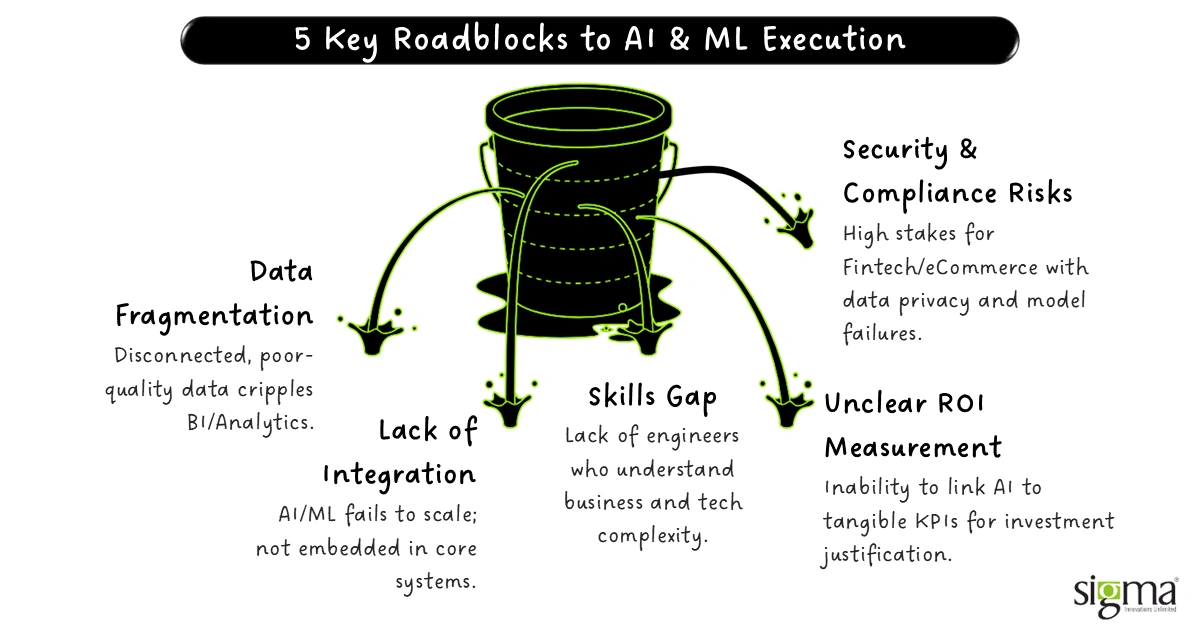
- Data Fragmentation: Disconnected, siloed, or poor-quality data prevents accurate model training. Without clean and unified datasets, even the smartest algorithms can’t generate reliable insights. This directly affects the success of business intelligence and analytics initiatives.
- Lack of Integration: Many enterprises treat AI/ML as stand-alone pilots rather than embedding them into existing workflows. Without seamless integration into CRMs, ERP systems, or digital platforms, their smart business solutions fail to scale.
- Skills Gap: There’s a shortage of in-house data scientists and engineers who understand both the business and technical sides of AI and ML. This gap makes it difficult to operationalize AI ML solutions or manage custom development services effectively.
- Unclear ROI Measurement: Leaders often struggle to connect AI initiatives with tangible business KPIs. Without clear metrics, it’s easy to question whether AI efforts are delivering value, especially when the impact is long-term or indirect.
- Security & Compliance Risks: In sectors like Fintech and healthcare, AI adoption raises questions about data privacy, model transparency, and regulatory compliance. One misstep in handling sensitive information can lead to costly setbacks.
These challenges can make AI/ML adoption feel like navigating a maze full of promise, but difficult to map.
That’s where Sigma Infosolutions steps in. We help enterprises simplify AI/ML adoption by combining analytical development services, Product Engineering Services, and intelligent automation services under one strategic framework. Our role is to bridge the gap between ambition and execution by transforming fragmented systems into AI-driven solutions that are secure, integrated, and ROI-focused.
Turning AI and ML into Business Outcomes
Enterprises today don’t just need AI strategies; they need AI-driven business outcomes. Sigma Infosolutions bridges this crucial gap, helping organizations evolve from exploring possibilities to executing scalable, intelligent solutions that make a measurable impact.
Bridging Theory and Implementation
AI and ML initiatives often stall between ideation and execution. Sigma helps enterprises move from AI “exploration” to ML “execution” by combining strategic consulting with hands-on engineering. Our teams specialize in translating conceptual AI goals into production-ready systems, ensuring that every algorithm serves a clear business objective, whether it’s improving decision-making, automating operations, or enhancing customer experiences.
1. Powered by Data-Driven Intelligence (BI & Analytics)
Every successful AI journey starts with high-quality data. Sigma builds clean, centralized data ecosystems using tools like Power BI, Tableau, and custom dashboard development. We help organizations unlock predictive analytics and actionable insights that fuel smarter strategies and faster decisions.
Explore Sigma’s BI & Analytics capabilities!
2. Engineering AI-Driven Solutions (Product Engineering)
Our Product Engineering Services team transforms machine learning models into scalable digital products. From algorithm development to system integration, Sigma enables businesses to embed intelligence across their existing platforms and customer journeys. Whether it’s an AI-infused lending solution or an automated eCommerce personalization engine, we help you engineer for both innovation and reliability.
Leverage our Product Engineering expertise
3. Custom AI & ML Solutions for Every Industry
No two industries face the same AI challenges, and Sigma’s solutions reflect that. Our domain experts design tailored use cases for Fintech, Retail, Manufacturing, and beyond:
- Fraud detection and credit scoring for Fintech.
- Recommendation engines and dynamic pricing for eCommerce.
- Predictive maintenance and process automation for operations.
Each implementation is backed by deep data expertise and a commitment to measurable outcomes.
Read more about Sigma’s AI & ML solutions!
Why Sigma?
What sets Sigma apart is our fusion of domain expertise and cross-platform development skills spanning Adobe Commerce, Salesforce, AWS, .NET, and ReactJS. With a proven track record of driving ROI through AI/ML transformation, we turn complex technologies into business-ready advantages.
At Sigma Infosolutions, we don’t just build AI; we build AI that works for business.
Also Read: ROI Beyond Technology: The Business Value of Enterprise Architecture Solutions
What Enterprises Should Prepare For (The Future of AI and ML)
The next wave of enterprise intelligence is already taking shape, and it’s defined by speed, transparency, and adaptability.
Generative AI is moving from hype to utility, enabling organizations to automate content creation, design, and decision-support workflows. Real-time machine learning, powered by edge intelligence, is helping enterprises act on insights as events unfold, from instant fraud detection to predictive maintenance. Meanwhile, Explainable AI (XAI) is gaining traction as businesses demand transparency, traceability, and compliance-ready algorithms they can trust.
For enterprise leaders, success in this evolving landscape will depend on more than deploying new technologies. It will hinge on three key imperatives:
- Data readiness: Ensuring clean, unified data pipelines that feed intelligent systems.
- Seamless integration: Embedding AI and ML capabilities within daily business operations.
- Collaborative ecosystems: Partnering with technology experts to scale innovation securely and sustainably.
At Sigma Infosolutions, we guide organizations through this evolution, from building AI foundations to scaling ML-driven innovation across the enterprise. With scalable, industry-aligned solutions that blend strategy, data, and engineering, Sigma helps businesses not just keep pace with change, but lead it.
Because the future doesn’t belong to enterprises that adopt AI, it belongs to those that make it work intelligently.
Conclusion
For enterprises, the difference between Artificial Intelligence (AI) and Machine Learning (ML) isn’t just a matter of definitions; it’s a question of business outcomes. AI represents ambition: the strategic vision of building intelligent systems that can reason, predict, and optimize. ML represents execution: the practical engine that turns data into actionable insights, powering automation, personalization, and predictive analytics. Together, they form the foundation of smart business solutions that drive measurable impact.
However, having an AI ambition without ML execution is like owning a high-performance car but leaving it in the garage. Success comes when enterprises combine AI’s vision with ML’s operational power, transforming ideas into tangible results.
This is where Sigma Infosolutions becomes the essential partner. By leveraging our BI & Analytics Development Services, Product Engineering Services, and AI and ML development services, we help organizations bridge the gap between potential and profit. From predictive analytics and intelligent automation services to tailored industry-specific AI and ML solutions, our experts empower enterprises to scale innovation confidently and securely.
Ready to turn AI ambition into measurable outcomes?
Partner with us to bring intelligence to your enterprise with our AI and ML Development Services. Transform conceptual strategies into actionable business value and lead the next era of data-driven, intelligent enterprises.