Magento Website Speed Optimization Services: Complete Guide to Faster Load Times & Higher Conversions (2026)

Key Highlights
- Slow Magento storefronts and poor Core Web Vitals scores can reduce conversions, increase bounce rates, and negatively affect both organic search visibility and paid advertising performance.
- Google reports that 53% of mobile users abandon websites that take longer than three seconds to load, making e-commerce speed a measurable revenue factor for online retailers.
- Even a one-second delay during the checkout experience can lead to lower customer retention and lost sales opportunities across high-traffic Magento stores.
- Sigma Infosolutions helps businesses address Magento performance challenges through Hyvä theme migration, front-end optimization, and server-level performance tuning designed to improve load times and storefront scalability.
Why Magento Performance Optimization Demands Deliberate Technical Action
Magento is among the most capable e-commerce platforms available, but its power comes with architectural complexity that directly affects site speed. Without systematic performance optimization, even well-built Magento stores accumulate technical debt that slows page load times and erodes the user experience over time. The relationship between Magento optimization and business outcomes is not indirect: slower stores produce fewer conversions, higher bounce rates, and declining search visibility.
The default Magento front-end, built on the Luma theme stack with Knockout.js and RequireJS, generates substantial JavaScript payloads that modern browsers must parse before rendering a page. A standard Luma-based Magento site frequently scores in the 30 to 50 range on Google PageSpeed Insights, which places it below the threshold Google uses to classify pages as “good” for Core Web Vitals purposes. For merchants competing in saturated retail categories, this is a measurable disadvantage.
Load time improvement is not a one-time task. Magento environments change with every extension update, catalog expansion, or infrastructure modification, and each change can introduce new performance regressions.
Struggling with slow Magento performance and declining Core Web Vitals scores?
The Primary Causes of Slow Magento Stores
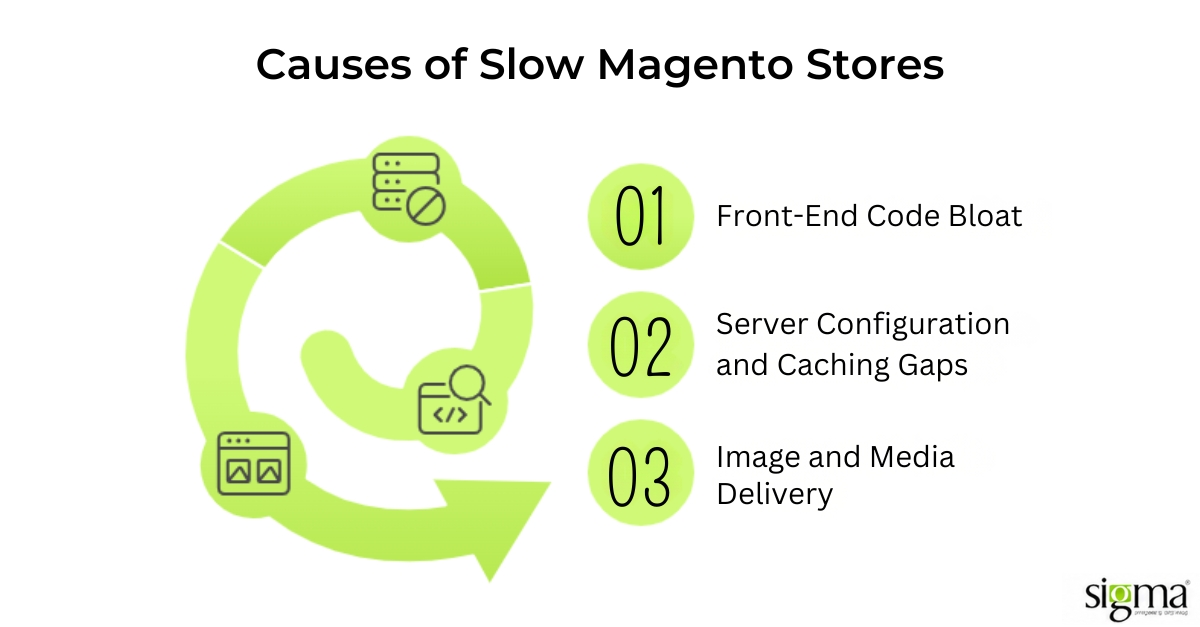
Front-End Code Bloat
The Luma theme architecture was designed for flexibility rather than speed. Each page request on a Luma-based store loads multiple JavaScript and CSS files, many of which are not required for the specific page being rendered. This results in excessive network payloads and delayed First Contentful Paint (FCP) scores that signal poor performance to both users and search engines.
Third-party extensions compound the problem. Most Magento stores rely on 20 or more extensions, and each one can inject additional JavaScript into the global scope. Without a disciplined audit process, extension-related code accumulates silently and contributes to degraded e-commerce speed across the entire catalog.
Server Configuration and Caching Gaps
Magento’s full-page cache, when properly configured with Varnish, can eliminate most database queries for anonymous users. However, misconfigured cache headers, missing Redis integration for session storage, and inadequate PHP-FPM pool settings are common gaps that force the server to rebuild pages unnecessarily.
Hosting infrastructure matters significantly. Shared hosting environments, even those marketed as “Magento-compatible,” routinely lack the CPU and RAM allocation required to serve a mid-size catalog under real traffic conditions. Moving to a properly provisioned cloud environment on AWS with appropriately sized instances resolves a large portion of server-side latency without any code changes.
Image and Media Delivery
Unoptimized product images are one of the most consistent contributors to slow load times in Magento stores. Large JPEG or PNG files served without WebP conversion or responsive sizing force mobile users to download files several times larger than their screen can display. Properly implementing a CDN for media delivery reduces latency for geographically distributed customers and offloads static asset serving from the origin server.
Performance Optimization Benchmarks: Before and After
Optimization Area | Typical Unoptimized State | Post-Optimization Target |
| Google PageSpeed Score (Mobile) | 25 to 45 | 85 to 95 |
| Largest Contentful Paint (LCP) | 5 to 8 seconds | Under 2.5 seconds |
| Total Blocking Time (TBT) | 800ms to 2,000ms | Under 200ms |
| Page Weight (Homepage) | 4MB to 8MB | Under 1.5MB |
| Time to First Byte (TTFB) | 1.2 to 2.5 seconds | Under 600ms |
Key Technical Approaches to Magento Speed Optimization
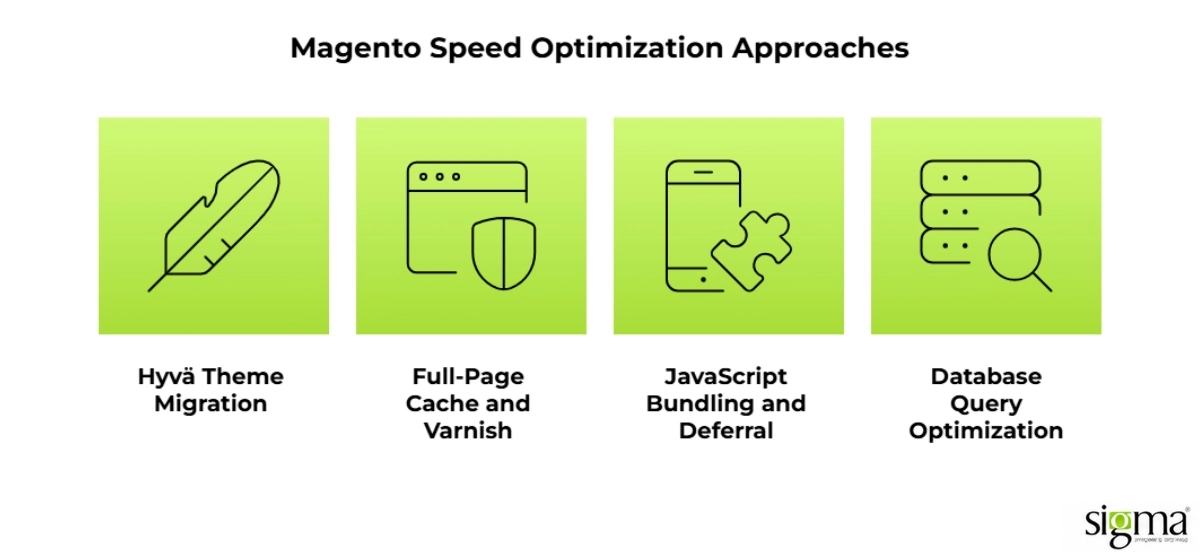
Hyvä Theme Migration
The Hyvä theme replaces the Luma front-end with a lightweight stack built on Tailwind CSS and Alpine.js. This architectural shift eliminates the Knockout.js dependency and dramatically reduces the JavaScript payload on every page. Stores that migrate to Hyvä consistently achieve PageSpeed scores above 90 on mobile, a result that is structurally difficult to reach with Luma-based themes, regardless of how aggressively they are optimized.
Hyvä is not a drop-in replacement and requires compatibility work for existing extensions. However, the investment produces measurable returns: improved Core Web Vitals, higher organic search rankings, and a front-end codebase that is simpler to maintain over time.
Full-Page Cache and Varnish Configuration
Varnish Cache, when integrated correctly with Magento’s built-in cache invalidation system, allows the majority of storefront requests to be served from memory without touching the PHP application or the database. Configuring the correct VCL (Varnish Configuration Language) rules, setting appropriate TTL values, and ensuring cache warming routines are scheduled correctly are all steps that require direct knowledge of Magento’s cache management architecture.
Redis should be used for both session storage and the Magento default cache backend. Relying on the filesystem for either introduces I/O bottlenecks that worsen under concurrent traffic.
Also, read the blog: Every Second Counts: Zero Downtime Deployment with Magento Open Source Solutions
JavaScript Bundling and Deferral
Magento’s built-in JavaScript bundling feature is often counterproductive when misconfigured, as it can produce bundles that are larger than the individual files they replace. A correct implementation involves identifying critical rendering path scripts, deferring non-essential JavaScript, and using browser caching headers to allow repeat visitors to load cached assets rather than re-downloading them.
Database Query Optimization
Long-running MySQL queries are a common performance bottleneck in Magento stores with large catalogs or complex pricing rules. Enabling the MySQL slow query log, analyzing queries with EXPLAIN, and adding targeted indexes to the catalog product index tables are practical steps that improve backend response times without requiring infrastructure changes.
Also, Read the blog: Is Site Speed the Grinch Stealing Your Sales? The Case for Website Performance Optimization
How Sigma Infosolutions Supports Long-Term Magento Performance Strategy
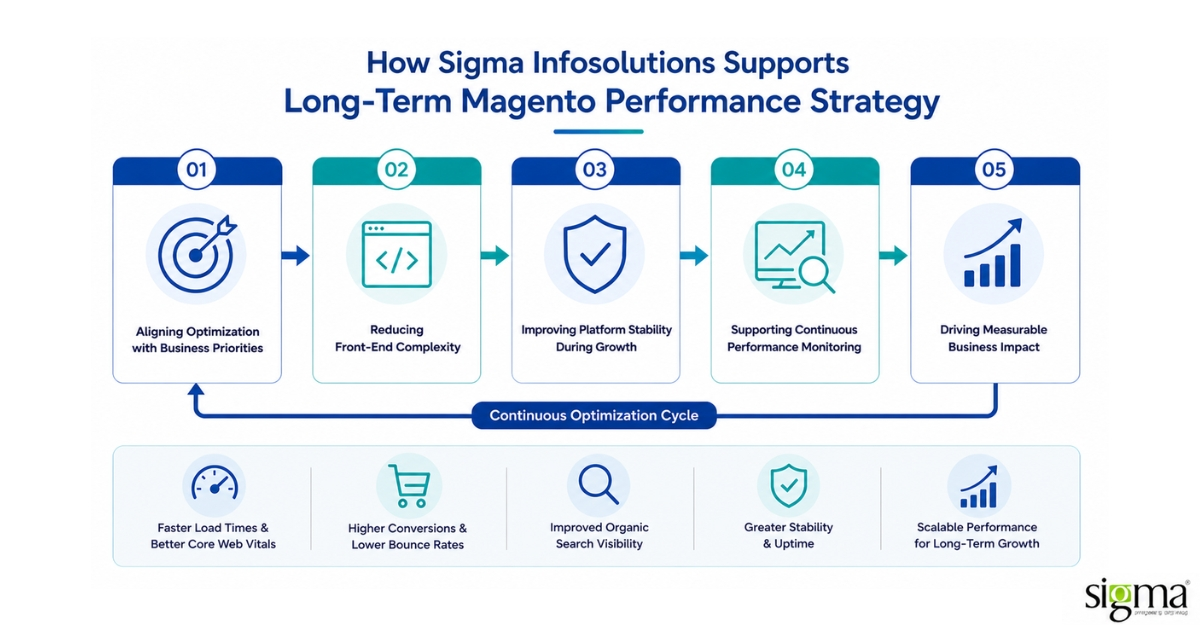
Magento performance challenges rarely come from a single issue. As e-commerce businesses expand product catalogs, integrate third-party systems, and introduce new customer experiences, performance dependencies increase across the entire storefront ecosystem.
Improving site speed requires balancing front-end performance, infrastructure scalability, extension compatibility, and operational continuity without disrupting the customer experience. Sigma Infosolutions approaches Magento optimization with a long-term engineering mindset focused on sustainability, scalability, and measurable business performance.
Aligning Optimization with Business Priorities
Not every performance issue affects revenue equally. Sigma’s optimization approach prioritizes improvements based on how customers interact with the storefront, where conversion friction exists, and which performance gaps impact search visibility most significantly.
This allows businesses to focus technical efforts on areas that influence:
- Mobile shopping experiences
- Checkout completion rates
- Product discovery and navigation
- Organic search performance
- High-traffic campaign landing pages
Rather than treating optimization as a purely technical exercise, the process is tied directly to customer experience and revenue performance.
Reducing Front-End Complexity
Modern Magento storefronts often accumulate unnecessary front-end complexity over time through customizations, extensions, and layered scripts added across multiple development cycles.
Sigma’s engineering teams streamline front-end delivery by reducing render-blocking resources, simplifying asset loading strategies, and modernizing storefront architecture where required. For businesses moving toward Hyvä, the focus is not only on speed gains but also on creating a cleaner and more maintainable front-end foundation for future growth.
Improving Platform Stability During Growth
Performance issues frequently become more visible during traffic spikes, seasonal campaigns, catalog expansion, or increased API activity from integrated systems.
Sigma supports Magento environments with infrastructure and scalability planning designed to improve stability under load. This includes evaluating caching behavior, resource allocation, cloud environment configuration, and application-level performance dependencies that can affect uptime and responsiveness during peak usage periods.
Supporting Continuous Performance Monitoring
Magento optimization is not static. Storefront performance changes over time as new features, integrations, and content updates are introduced.
Sigma helps businesses establish ongoing monitoring and performance governance practices so regressions can be identified early. This includes monitoring Core Web Vitals trends, server response behavior, extension impact, and storefront performance across devices and regions.
Continuous optimization helps prevent gradual performance decline that often goes unnoticed until conversion metrics begin to drop.
Conclusion
Magento performance optimization works best when approached as part of a broader e-commerce growth strategy rather than a short-term technical fix.
Sigma Infosolutions supports businesses with scalable Magento and Adobe Commerce engineering services focused on storefront speed, operational stability, modern front-end architecture, and long-term platform performance. By combining technical optimization with business-focused execution, Sigma helps e-commerce brands build storefronts designed to perform consistently as they grow.
Frequently Asked Questions
Q: What is Magento optimization, and why does it matter for e-commerce stores?
A: Magento optimization is the process of improving the technical performance of a Magento-based store to reduce page load times, improve server response, and enhance the user experience. It matters because site speed directly affects conversion rates, search engine rankings, and customer retention.
Q: How does website speed affect e-commerce conversion rates?
A: Research consistently shows that slower load times reduce the percentage of visitors who complete a purchase. A one-second improvement in load time can increase conversions by two to five percent for mid-size e-commerce stores, making website speed a direct contributor to revenue.
Q: What is the Hyvä theme, and how does it improve Magento load time?
A: Hyvä is a Magento front-end theme built on Tailwind CSS and Alpine.js that replaces the heavier Luma theme stack. It eliminates Knockout.js and RequireJS dependencies, which significantly reduces JavaScript payload and produces measurable load time improvement across all page types.
Q: Which server-side changes have the greatest impact on Magento e-commerce speed?
A: Configuring Varnish full-page cache correctly, using Redis for session and cache storage, and moving to a properly provisioned cloud hosting environment collectively produce the largest server-side speed gains. These changes reduce the number of PHP and database operations required per request.
Q: How long does a Magento performance optimization project typically take?
A: The timeline depends on the scope of work. A targeted optimization engagement covering caching, image delivery, and JavaScript deferral can be completed in three to five weeks. A full Hyvä theme migration for an established store with multiple extensions typically requires eight to sixteen weeks.
Q: What is the relationship between conversion optimization and Core Web Vitals?
A: Google’s Core Web Vitals metrics (LCP, TBT, and CLS) measure aspects of the user experience that directly correlate with conversion behavior. Stores that meet Google’s “good” thresholds for these metrics tend to have lower bounce rates and higher engagement, both of which support conversion optimization.
Q: Can performance optimization be done on a live Magento store without causing downtime?
A: Most optimization tasks, including caching configuration, image optimization, and JavaScript deferral, can be implemented on a staging environment and deployed with minimal disruption. Infrastructure-level changes and Hyvä migrations require careful deployment planning but do not require extended downtime periods.
Q: What tools are used to measure Magento site speed performance?
A: Google PageSpeed Insights, Google Search Console’s Core Web Vitals report, GTmetrix, and New Relic are commonly used to measure and monitor Magento performance. Each tool provides distinct data points, and using more than one gives a more complete picture of where load time issues originate.