Preparing Your Payment Stack for New Year Sales: A Transaction Processing Guide

What’s the real cost of digital transformation delays? For global C-suite executives, the answer isn’t found in a ledger; it’s found in the wreckage of a failed peak season. Two decades of client partnerships show that when transaction processing falters, the erosion of brand equity is instantaneous. Whether we are supporting Silicon Valley startups or European enterprises, the mandate is the same: transform technical debt into a resilient revenue engine.
The Importance of Transaction Processing Reliability During Peak Sales
During Q4 retail peaks, the surge in consumer demand exposes every hairline fracture in your financial architecture. Reliable transaction processing is the heartbeat of this period; without it, you risk not just lost sales, but a permanent fracture in customer loyalty. Strategic growth is impossible without an infrastructure that prioritizes high uptime and automatic failover. By adhering to ISO 9001:2015 quality standards, we ensure that every authorization is a testament to operational excellence, maximizing conversions when the stakes are highest.
Understanding Transaction Processing in High-Volume Environments
Efficient processing in high-volume environments is a game of milliseconds. Here’s what surprises most executives: the primary cause of failure isn’t always volume—it’s the inability of the system to manage concurrent requests and robust error handling simultaneously. Two decades of technology evolution have taught us that a scalable payment architecture must be elastic enough to breathe with the market.
Key Components of a Scalable Payment Stack for Peak Season

A resilient ecosystem for peak season must be fast, reliable, and inherently flexible. We have seen a 60% speed improvement in transaction processing by re-engineering legacy systems into modular, cloud-ready architectures. Essential components include:
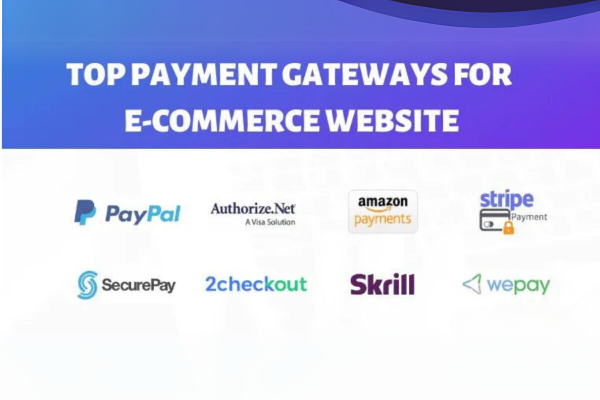
- High-performance gateways (e.g., Stripe or PayPal)
- Load-balanced infrastructure to absorb traffic spikes
- Automated failover systems to ensure zero-touch recovery
- Multi-currency support to facilitate global commerce
Payment Orchestration and Routing for Optimized Transaction Flow
Payment orchestration acts as the central intelligence of your financial stack, dynamically directing transactions to the most efficient gateways based on success rates and regional fees.
| Business Metric | Fragmented Legacy Systems | Orchestrated Global Solutions |
|---|---|---|
| Authorization Speed | Variable/Unpredictable | Optimized/Low Latency |
| Approval Rates | Manual & Static | Dynamic & Maximized |
| Operational Risk | Single Point of Failure | Multi-Gateway Redundancy |
| Cross-Border Cost | High (Flat Rate) | Optimized (Regional Routing) |
This automation ensures a seamless fallback during peak loads without requiring manual intervention from your team.
Integrating Merchant Systems and Payment Gateways for Seamless Processing
True value is realized when your merchant systems and gateways operate as a singular, unified ecosystem. By leveraging APIs and orchestration, you unify inventory, order management, and payments into a high-velocity workflow. This integration reduces human error and accelerates the authorization cycle—a critical factor for enterprises managing hundreds of thousands of concurrent transactions across European and North American markets.
Assessing and Optimizing Payment Infrastructure for New Year Sales
Regular assessment is the bedrock of peak-season readiness. Executives must demand rigorous testing of transaction speeds and gateway uptime. Optimization involves more than just software; it requires refining API integrations and ensuring your infrastructure is built on the foundation of major hyperscalers—AWS, Microsoft, or Google Cloud.
Identifying Infrastructure Bottlenecks and Implementing Retries
Pinpointing the exact component causing latency—whether it’s an overloaded server or network friction—is essential. Implementing automatic retries with exponential backoff allows the system to handle transient failures gracefully, ensuring higher success rates without overwhelming the core architecture.
Continuous Payment Monitoring and Analytics for Proactive Issue Resolution
A Top Founder of a BI company, emphasizes that data is only valuable if it provides real-time actionable intelligence. Continuous monitoring via alerts and dashboards allows us to identify bottlenecks before they impact the bottom line. By tracking error patterns in real time, we transform reactive troubleshooting into proactive issue resolution, safeguarding customer trust.
Selecting and Leveraging Payment Service Providers for Peak Performance

Selecting a provider is a strategic decision that impacts global reach and integration ease. We evaluate leaders like Stripe and PayPal not just on fees, but on their ability to handle the specific scalability demands of global enterprises.
Comparative Overview of Leading PSPs(Payment Service Providers): Stripe, PayPal, Square, Heartland
- Stripe: Ideal for fast growth and developer-centric API flexibility.
- PayPal: Essential for broad consumer trust and massive global reach.
Strategic Integration and Payment Stack Enhancement
Strategic integration is the catalyst for unified workflows. Automating reconciliation and ensuring real-time data syncing across the enterprise reduces the administrative burden and accelerates cash flow. This creates a high-performance environment where technology serves the business, not the other way around.
Building a Resilient Payment Architecture with Multi-PSP Routing
Multi-PSP routing is the ultimate insurance policy for global commerce. By distributing transactions across several providers, you mitigate the risk of a single-provider outage and optimize costs through dynamic gateway selection based on regional success rates.
Automating Payment Retries to Maximize Transaction Success
Automation is the key to maximizing transaction success without manual overhead. Strategies like limited retry attempts and intelligent backoff ensure higher approval rates and smoother cash flow, even during the most intense Q4 surges.
Security and Compliance Considerations for High-Volume Transaction Processing
Security and compliance are non-negotiable pillars of a modern payment stack. Implementing PCI DSS standards and ensuring GDPR compliance are not just regulatory hurdles—they are trust signals to your global clientele.
Ensuring Data Security Across Payment Channels
Protecting sensitive information requires a multi-layered approach:
- Tokenization to shield card details
- End-to-end encryption across all channels
- Continuous fraud monitoring to detect anomalies in real time
Maintaining Compliance with Industry Regulations During Peak Loads
Compliance must never be sacrificed for speed. By automating encryption and tokenization, we ensure that your enterprise remains secure under even the heaviest peak loads, avoiding costly penalties and safeguarding your reputation.
Preparing for New Year Sales: A Strategic Payment Stack Readiness Checklist
To ensure your ecosystem is battle-ready, verify these critical areas:
- Test gateway scalability and speed limits.
- Verify multi-PSP routing and failover responsiveness.
- Automate payment retries and error handling.
- Confirm global compliance (PCI DSS, GDPR).
- Monitor all transaction flows with real-time analytics.
- Leverage Sigma’s digital payment solutions
How Sigma Infosolutions Enhances Payment Stack Reliability and Optimization
With over two decades in business, Sigma Infosolutions acts as a dual-vertical specialist in Fintech and eCommerce. We provide the full-lifecycle support necessary to re-engineer legacy systems, achieving milestones like single-day funding records for our clients. Our expertise in multi-PSP routing and proactive monitoring ensures your architecture is as ambitious as your business goals.
Conclusion: Achieving High-Volume Payment Reliability for Peak Sales Success
Achieving success in high-volume environments requires a shift from reactive maintenance to proactive, resilient architecture. By prioritizing payment orchestration, security, and strategic integration, you ensure that your business is not just prepared for the New Year, but positioned for long-term global leadership.
FAQs
1. Why is payment stack preparation critical for New Year sales?
New Year sales bring peak transaction volumes that expose weaknesses in payment infrastructure. A well-prepared payment stack ensures high uptime, faster authorizations, and protects revenue and brand trust during demand surges.
2. What causes transaction failures during high-volume sales periods?
Most transaction failures stem from poor concurrency handling, lack of gateway redundancy, slow authorization logic, and insufficient error recovery—not just traffic volume alone.
3. How does payment orchestration improve transaction success rates?
Payment orchestration dynamically routes transactions across multiple gateways based on performance, region, and fees. This reduces failure rates, improves approval percentages, and eliminates single points of failure.
4. How can enterprises maintain security and compliance during peak payment loads?
Enterprises maintain security by implementing PCI DSS compliance, tokenization, end-to-end encryption, automated fraud monitoring, and GDPR-aligned data handling—even under extreme transaction volumes.
5. How does Sigma Infosolutions help enterprises optimize payment stacks for peak sales?
Sigma Infosolutions helps enterprises re-engineer payment stacks through multi-PSP routing, API orchestration, cloud scalability, automated retries, and real-time monitoring to ensure peak-season reliability.