The Modern Wealth Management Tech Stack: What Every RIA and Advisory Firm Needs Today

Key Takeaways:
- Disconnected tools are creating a hidden “growth tax,” consuming up to 20% of productivity through manual data movement.
Firms need a unified tech stack to scale efficiently. Sigma Infosolutions builds integrated ecosystems that eliminate re-keying and create a single source of truth. - Adding more SaaS tools is increasing complexity, resulting in a “Franken-stack” that cannot scale.
Scalability comes from connected architecture, not more vendors. Sigma consolidates legacy systems and engineers seamless integrations across the stack. - Fragmented technology is lowering firm value and increasing risk in an M&A-driven market.
Modern firms need clean, integrated platforms. Sigma transforms disconnected systems into scalable, high-performance assets that improve operational efficiency and valuation.
Today, the average RIA (Registered Investment Advisor) is literally drowning in innovation. It sounds backwards, right? We were told that buying the “best-of-breed” tools, the flashiest CRM, the latest risk profiler, and the coolest reporting app, would give us a massive edge. Instead, most firms have accidentally built a “Franken-stack” made of 6 to 10 apps that refuse to speak the same language.
This wealth management technology stack clutter isn’t just an IT headache, but a heavy anchor dragging down your firm’s total value. When your team spends more time fighting software than helping clients, you aren’t just losing hours; you are losing trust and risking client churn. To survive today’s shift toward professional, institutional-grade wealth management, you have to stop “buying tools” and start “engineering ecosystems.” This is where Sigma Infosolutions steps in.
We specialize in Financial Software Development Services and Investment Software Solutions that help firms move past the mess of disconnected legacy tools. By focusing on a unified architecture, we turn your technology from a recurring operational nightmare into a scalable, high-performance asset that actually grows with you.
Turn your “Franken-stack” into a scalable advantage.
The Anatomy of a “Franken-Stack” & Why Your Data is Dying
Most RIA principals don’t realize their data is dying a slow death until an audit hits or a major client leaves. The problem is what we call the “Re-keying Ritual.” Your team is likely stuck manually typing the same client info into Orion, then Wealthbox, then Riskalyze. This leads to “NIGO” (Not In Good Order) errors that stall your growth.
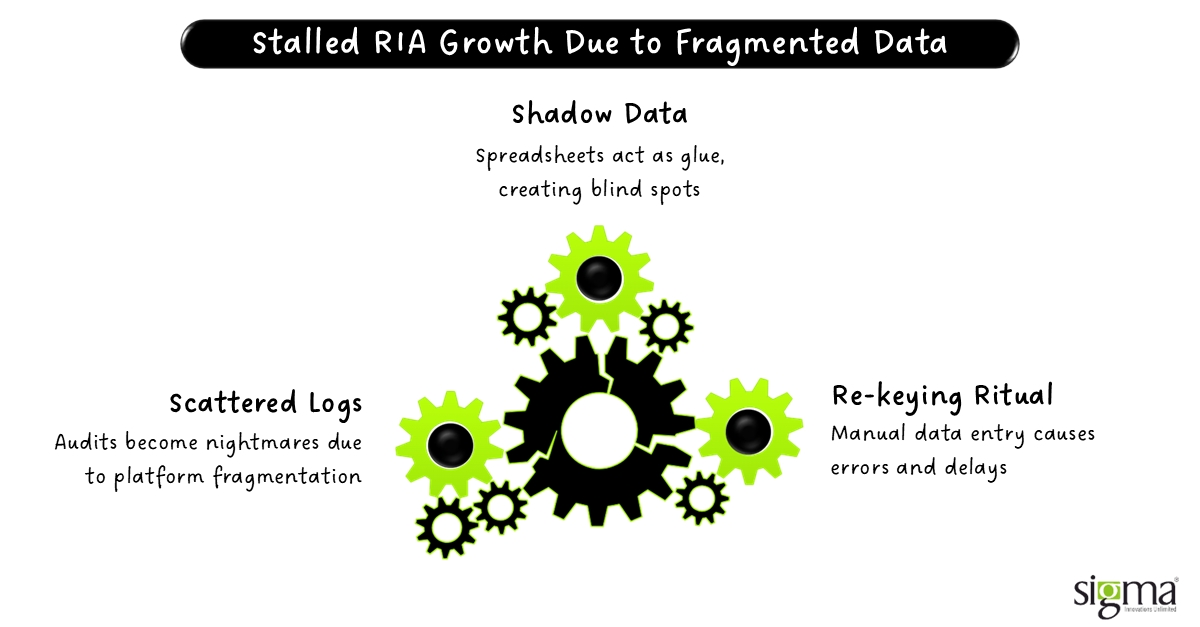
Recent industry data suggests that manual data reconciliation can eat up to 20% of an advisor’s productive time, a figure expected to rise as data complexity grows through 2027.
Because your RIA tech stack is fragmented, your staff probably uses “Shadow Data“, basically a graveyard of messy spreadsheets, to act as the glue because your CRM won’t talk to your custodian. This creates massive compliance management for RIAs’ blind spots.
If your logs are scattered across five different platforms, a simple audit becomes a week-long nightmare. Your wealth management platform should behave like a flywheel that gains speed as you add clients, not a series of silos that slow you down. If your data doesn’t flow smoothly from onboarding to reporting, your firm simply cannot scale to the next level.
Also, read the blog – Building an Investor Dashboard Under Tight Deadlines: Architecture Decisions That Make or Break Fundraising Timelines
Deconstructing the Modern Wealth Core with A Layered Architecture
To fix a broken system, you have to stop shopping for individual gadgets and start looking at a blueprint. Think of your wealth management technology stack like a three-story building. If the foundation is cracked, it doesn’t matter how expensive the paint in the living room is. To build a firm that actually works, you need to shift your focus from “which vendor should I buy?” to “how do these layers connect?“
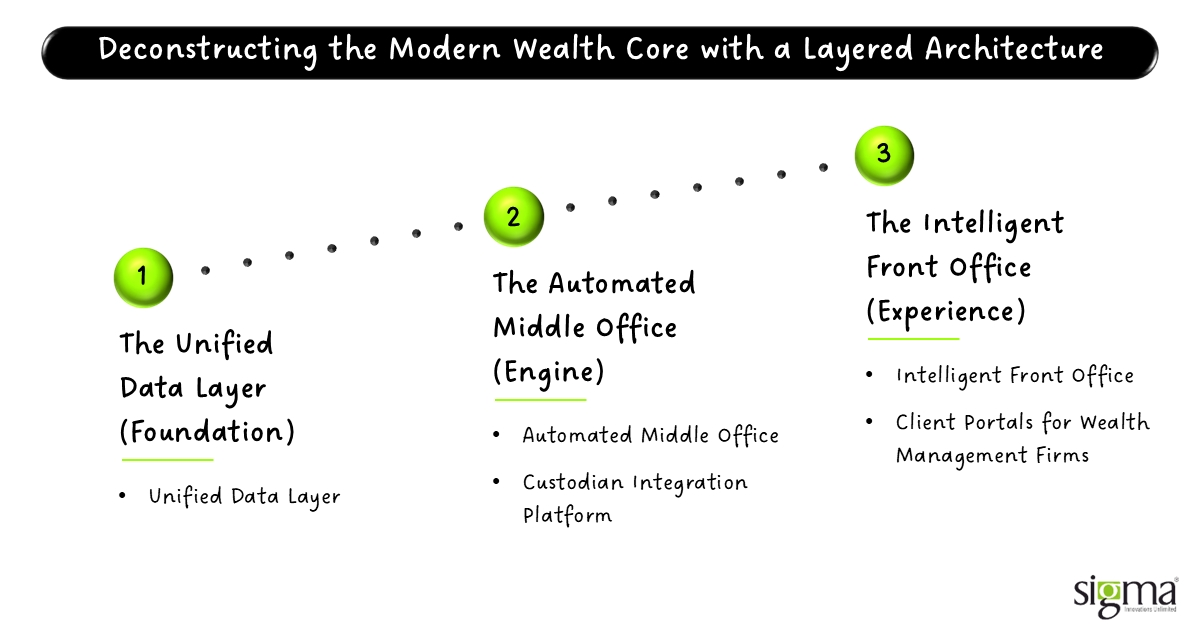
Layer 1: The Unified Data Layer (Foundation)
Everything starts here. Most firms rely on basic data aggregation, which is just a fancy way of saying they pull in numbers from different places. But a true unified wealthtech platform creates a “Single Source of Truth.” This means when a client changes their address in the CRM, it automatically updates the portfolio management software for RIAs and the billing system. There is no guessing which data is correct because the foundation is solid.
Layer 2: The Automated Middle Office (Engine)
This is where the heavy lifting happens. A modern wealth management platform uses a custodian integration platform to talk directly to big names like Schwab or Fidelity. Instead of your team logging into five different sites to move money or rebalance a portfolio, robust APIs do the work for you. This middle layer connects your strategy to the actual market, turning manual chores into an automated engine that runs while you sleep.
Layer 3: The Intelligent Front Office (Experience)
This is what your clients actually see. A high-end client portal for wealth management firms shouldn’t just show a balance. It should combine deep financial planning, like eMoney or MoneyGuidePro, with real-time reporting. By using RIA portfolio management software that feeds directly into a sleek, branded dashboard, you give clients a “window” into their wealth that feels professional and high-tech, not clunky and outdated.
Stop being the “middle man” for your own software with Sigma’s Financial Software Development Services that automate your workflows from the ground up!
From “Bolt-On” to “Purpose-Built” Wealth Management Tech Stack (The Sigma’s Engineering Approach)
In the wealth management world, many leaders fall into the “Platform Paradox.” This is the mistaken belief that if a workflow is broken, buying one more SaaS subscription will magically fix it. In reality, adding more software to a messy system is like trying to fix a traffic jam by adding more cars. At Sigma, we see things differently. True strategic maturity isn’t about having the longest list of vendors, but about legacy system consolidation for RIAs.
We help firms move away from “software implementation“, which is just installing a tool and hoping for the best, and move toward “Platform Engineering.” This means we don’t just give you a login; we build the custom connectors and data pipelines that allow your Salesforce CRM and AWS cloud environment to actually talk to your RIA software solutions. By auditing your current stack, we often find that an 8-tool mess can be consolidated into a high-performance 3-tool core. This shift transforms your technology from an expensive “bolt-on” expense into a custom-engineered asset that increases your firm’s enterprise value.
Read our success story – Accelerating Lending Operations with AWS-Powered Scalability
Emerging Trends in AI-Augmented Wealth Management Technology Stack
As we move through this year, the conversation around Artificial Intelligence has shifted. It is no longer about “AI as a chatbot” that gives canned answers. The future is “Agentic AI.” We are now seeing wealth management software powered by workflow agents that handle wealth management client onboarding software tasks and proactive compliance management for RIAs without human intervention. These agents can spot a paperwork error or a suspicious trade in milliseconds, long before a human auditor would see it.
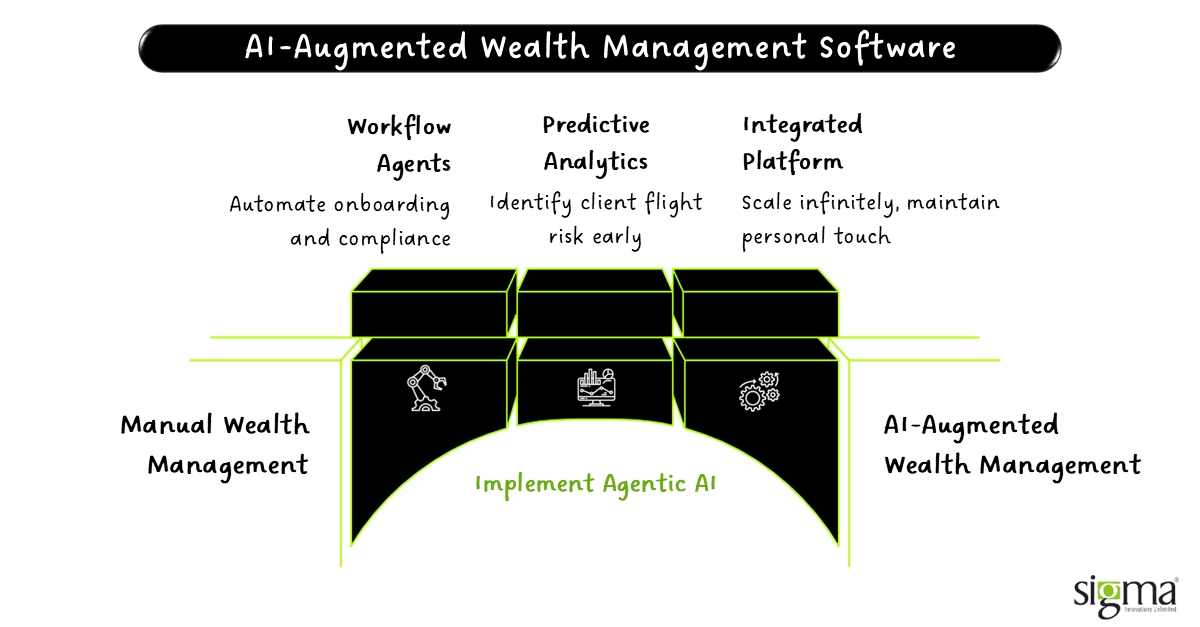
Furthermore, predictive BI & Analytics are changing the game. Forward-thinking firms are using data to spot “client flight risk” by analyzing subtle changes in login patterns or communication frequency. Research suggests that by 2027, AI-driven automation will allow the top 10% of advisors to manage upwards of $500M+ in AUM without any drop in service quality. By adopting an integrated wealth management platform, you aren’t just keeping up; you’re building a firm that can scale infinitely while maintaining that personal touch.
Also, read the blog: Top 10 Investment Technology Trends to Watch in 2026
The 4-Step Roadmap to Modernize Your Wealth Management Technology Stack
Modernizing your wealth management technology stack doesn’t have to happen all at once, but it does need to be methodical. If you want to stop the “Franken-stack” from growing, follow this four-step execution plan:
Step 1: The Friction Audit
Sit down with your operations team and find out where they are manually re-keying data. Every “copy-paste” action is a hidden tax on your growth.
Step 2: API-First Selection
From now on, never buy a tool that doesn’t have “Open API” maturity. Your RIA software solutions must be able to talk to each other without a human middleman.
Step 3: Centralize the Data
Move toward a unified wealthtech platform by building a central data warehouse. This ensures you own your firm’s history, even if you switch vendors later.
Step 4: Partner for Scale
The most successful RIAs are stopping the vendor hunt and starting technology partnerships. By working with experts who understand wealth management compliance software and engineering, you build a proprietary “moat” that competitors can’t easily copy.
Also, read the blog: Robo advisory: An opportunity or a threat for fintech?
Final Thoughts
Today, the gap between “tech-forward” and “legacy-trapped” firms is widening. In an era defined by rapid M&A and industry consolidation, firms with clean, unified systems fetch much higher valuations and deliver vastly better client outcomes. Technology is no longer just a support function; it is the very core of your firm’s value.
At Sigma Infosolutions, our engineering experts are ready to help you bridge the gap from fragmented tools to a high-performance ecosystem. Whether you are looking to integrate your wealth management CRM integration workflows or need a total legacy system consolidation for RIAs, we have the expertise to make it happen.
Your tech stack shouldn’t slow your growth.
Frequently Asked Questions (FAQs)
1. What is the best wealth management software for RIAs today?
While platforms like Salesforce Financial Services Cloud, Orion, and Addepar are leaders, the “best” software is the one that actually talks to your other tools. Today, the focus has shifted from standalone apps to “Agentic AI” and integrated ecosystems that eliminate manual data entry.
2. How do I consolidate advisor technology platforms without disrupting my business?
Consolidation starts with a “Friction Audit” to find where data is being re-keyed. Instead of a “rip and replace” approach, Sigma focuses on Layered Architecture by building a unified data layer that connects your existing CRM, custodian, and reporting tools into a single source of truth.
3. Portfolio Management Software vs. CRM: Which one should be my “hub”?
Historically, firms chose one or the other. Today, the “hub” should be your Unified Data Layer. Your CRM (like Wealthbox or Salesforce) manages the relationship, while Portfolio Management (like Orion or Black Diamond) manages the assets. Sigma’s engineering ensures these two “brains” share one nervous system.
4. What does a modern wealth management platform architecture look like?
Think of it as a three-story building: 1) A Unified Data Layer (Foundation), 2) An Automated Middle Office (API-driven engine), and 3) An Intelligent Front Office (Client Experience). If these layers aren’t connected by robust APIs, you don’t have a stack; you have a silo.