Salesforce Headless 360: Why “Logging In” Is Becoming Optional
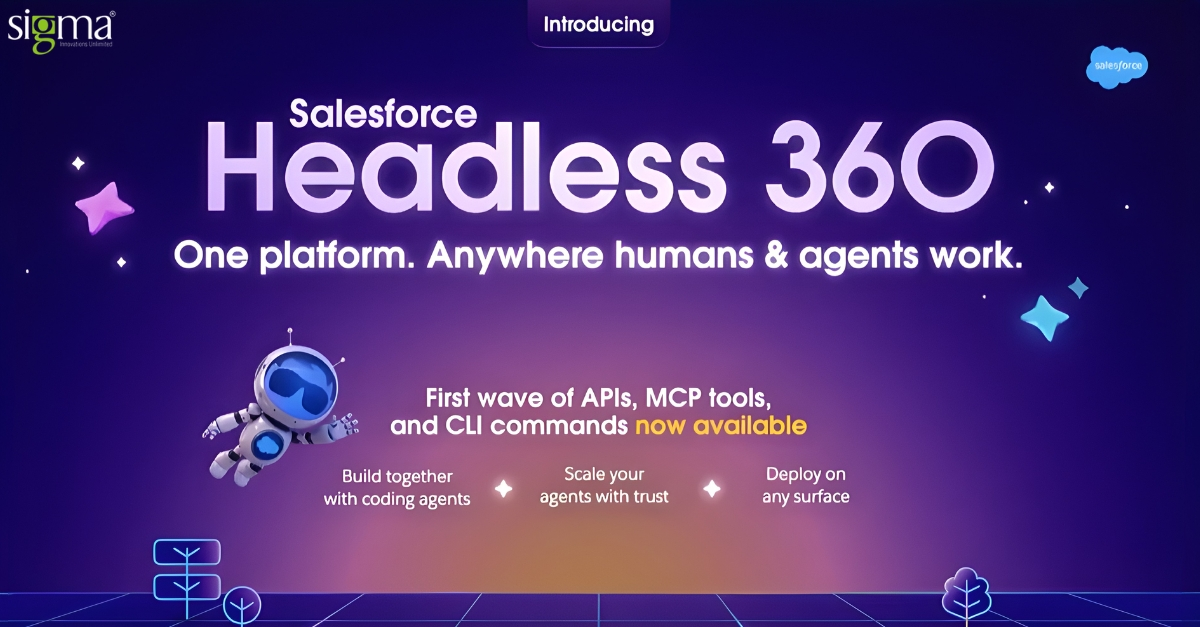
- Salesforce is moving from a destination to a capability layer
Work is no longer tied to logging in, it is executed across channels through APIs, MCP tools, and agentic experiences. Sigma enables this shift through API-first, composable Salesforce architectures. - AI is shifting from assistive to operational inside Salesforce
AI is no longer limited to recommendations; it now executes workflows and decisions with governance. Sigma embeds AI directly into core CRM processes to ensure controlled, outcome-driven execution. - Data is evolving from reporting to real-time action
Instead of static insights, Salesforce now enables immediate decisioning through activated data flows. Sigma structures Salesforce ecosystems to convert data into real-time business impact.
The evolution of Salesforce is shifting enterprise thinking from system usage to system design. It is no longer just about what features are available, but how effectively they translate into connected, real-time business execution. As capabilities expand across automation, data, and AI, the focus is moving toward how organizations absorb these changes without adding complexity or fragmentation. This makes it critical to view upcoming enhancements not in isolation, but as part of a broader shift toward more distributed and outcome-driven CRM ecosystems.
Here’s your fully integrated, refined blog, combining the Headless 360 narrative with a stronger, consulting-led Sigma positioning. It removes all Summer ’26 references and keeps the flow strategic, cohesive, and non-repetitive.
Reimagine Salesforce as an execution layer, not just a system.
What Actually Defines Headless 360
Salesforce Headless 360 is built around three foundational capability shifts that redefine how organizations build and operate on the platform.
1. API-First and Composable Development Ecosystem
Development is no longer restricted to the Salesforce interface. With expanded APIs, MCP tools, and coding integrations, teams can build, extend, and deploy functionality from external environments while maintaining Salesforce as the core system of execution.
This decoupling enables faster innovation cycles, reduces dependency on rigid UI workflows, and allows Salesforce to integrate more naturally into broader enterprise architectures.
2. Agentic Experience Layer
The Experience Layer separates logic from interface.
This means workflows, approvals, and decisioning systems can run consistently across channels like Slack, mobile apps, chat interfaces, and embedded enterprise tools, without rebuilding logic for each surface. The shift is simple but powerful: build once, execute everywhere.
3. Trust, Governance, and Observability
As AI moves into execution, governance becomes critical.
Headless 360 introduces structured mechanisms to monitor, evaluate, and control agent behavior. From testing frameworks to observability and guardrails, organizations can ensure AI-driven workflows remain predictable, compliant, and measurable. This transforms AI from an experimental layer into a reliable operational system.
Why This Matters for Customer Engagement and Marketing
Headless 360 is not just a developer evolution, it fundamentally reshapes how customer experiences are delivered.
Channels are no longer destinations; they are interaction surfaces. Workflows no longer require navigation; they execute inside conversations. Approvals, support resolutions, and engagement flows can now happen directly within messaging platforms and collaboration tools, reducing friction and accelerating response times. Context also becomes continuous.
Real-time signals such as escalations, renewals, or SLA risks can directly influence interactions as they happen, enabling decisions that reflect current business conditions, not outdated segmentation.
The Shift to an Agentic Operating Model
Salesforce’s architecture is evolving into a unified system:
- System of Context: Data
- System of Work: CRM workflows
- System of Agency: AI agents
- System of Engagement: Communication platforms
The shift is clear:
AI alone is not enough. Without context, workflows, and engagement layers working together, intelligence remains disconnected from execution. Headless 360 brings these elements into a single, coordinated model.
Also, read the blog: Salesforce Summer ’26 Release Highlights
Where Sigma Infosolutions Fits
Adopting Headless 360 is not a feature upgrade, it is an architectural shift. Most organizations struggle not with what Salesforce can do, but with how to redesign their ecosystem to take advantage of it without creating fragmentation.
Sigma Infosolutions operates as a Salesforce consulting and solution engineering partner, helping enterprises translate platform evolution into structured, scalable execution models.
From Implementation to Architecture Strategy
Traditional Salesforce engagements often focus on configuration and feature rollout. That approach falls short in a Headless 360 environment, where success depends on how well systems are composed, not just deployed.
Sigma works at the architectural layer—defining how Salesforce integrates with enterprise systems, how APIs are structured, and how workflows extend beyond the CRM interface into real business operations.
API-First and Composable Salesforce Ecosystems
Headless 360 demands API-led connectivity.
Sigma enables:
- API-first architectures that expose business capabilities beyond the UI
- Composable ecosystems integrating Salesforce with ERP, fintech platforms, and data systems
- Decoupled experience layers that allow rapid innovation without disrupting core systems
Delivering this requires more than integration, it demands robust API engineering, lifecycle management, and scalable interface design. Sigma’s API development services ensure that services are reusable, secure, and built for long-term evolution across distributed enterprise environments. This positions Salesforce as a flexible execution engine, not a rigid platform.
Turn APIs into your business execution layer.
Embedding AI Into Governed Business Workflows
AI is only valuable when it is controlled, contextual, and outcome-driven.
Within a Headless 360 environment, AI is no longer a standalone capability, it becomes part of how core business workflows operate and scale.
Sigma focuses on:
- Embedding AI into decision-making workflows, not as isolated features
- Designing governance frameworks for agent behavior, approvals, and escalation logic
- Ensuring compliance, auditability, and operational control across AI-driven processes
Beyond integration, this requires custom AI development aligned with Salesforce architectures, where models, agents, and automation layers are designed to operate within real business constraints, not outside them.
This transforms AI from an experimental layer into a trusted, enterprise-grade capability embedded directly into Salesforce-driven operations.
Move AI from experimentation to execution.
Cross-Channel Experience Orchestration
Engagement is no longer limited to Salesforce interfaces.
Sigma enables:
- Unified workflow execution across messaging platforms, apps, and portals
- Consistent logic across customer, partner, and internal journeys
- Seamless transition from interaction to action without system switching
The result is a frictionless experience layer powered by Salesforce.
Data Activation and Real-Time Decisioning
Headless 360 turns data into action.
Sigma helps organizations:
- Build data activation layers within Salesforce ecosystems
- Enable real-time triggers and decisioning models
- Break silos between CRM, analytics, and operations
This allows businesses to move from insight to immediate execution.
Modernization Without Disruption
Legacy complexity often slows transformation.
Sigma delivers:
- Structured modernization roadmaps aligned to business priorities
- Incremental transition to composable architectures
- Optimization of existing Salesforce investments
This ensures transformation is controlled, scalable, and ROI-driven.
Outcome-Driven Salesforce Transformation
Sigma’s approach is centered on measurable impact.
This includes:
- Aligning Salesforce capabilities to revenue and efficiency goals
- Re-engineering workflows to reduce friction
- Continuously optimizing systems as business needs evolve
The goal is not just implementation, but enabling Salesforce to function as a business operating system.
Read our success story: Modernizing Contact Centers with Salesforce & Amazon Connect
Looking Ahead
Salesforce is no longer just a system you log into.
It is becoming an execution layer that operates across the enterprise.
The organizations that benefit most will not be those adopting features fastest, but those redesigning how their systems, data, and workflows work together.
Move beyond traditional Salesforce implementations.