The Full Loan Lifecycle: How to Automate Every Stage from Origination to Payoff
Key Takeaways:
- Most lenders don’t lose money on bad math, but they lose it in the manual gaps between systems. We help you turn those disconnected silos into a single, high-speed data stream.
- If your solution to more loans is “hire more people,” your tech is failing you. Sigma’s architecture lets you double your volume without doubling your staff.
- Stop putting digital duct tape on legacy rot. We build cloud-native, AI-driven ecosystems that turn lending from a slow relay race into a real-time event.
Most lenders don’t lose money during underwriting, but in the gaps between their systems. Imagine a relay race where runners stop to fill out a form before passing the baton. That is exactly how most traditional lending operations function today. While your front-end may look sleek, the “handoff tax” behind the scenes is steadily draining profitability. Every transition from intake to underwriting to servicing introduces manual rework and system lag, creating a “black hole” of latency.
By the end of this year, experts predict that firms failing to integrate their data streams will see operational costs rise by 15% due to legacy friction. Leading firms are no longer just looking for a quick fix, but are also investing in Financial Software Development Services to build unified, cloud-native ecosystems. At Sigma Infosolutions, we believe the loan lifecycle isn’t just a business process anymore. It is a high-stakes data-sync challenge. To win, you need to stop thinking about checklists and start thinking about your digital lending as a single, immutable stream of information.
Why Loan Lifecycle Automation Fails in Modern Digital Lending Software
Think of your current setup. You likely have one piece of loan origination system software for the application, a separate tool for document storage, and a completely different loan management system for the actual billing. These are disconnected islands. When a borrower hits “submit,” their data often sits in a digital waiting room until a human moves it to the next stage. This “Architectural Rot” in the middle of the lifecycle is where the magic dies.
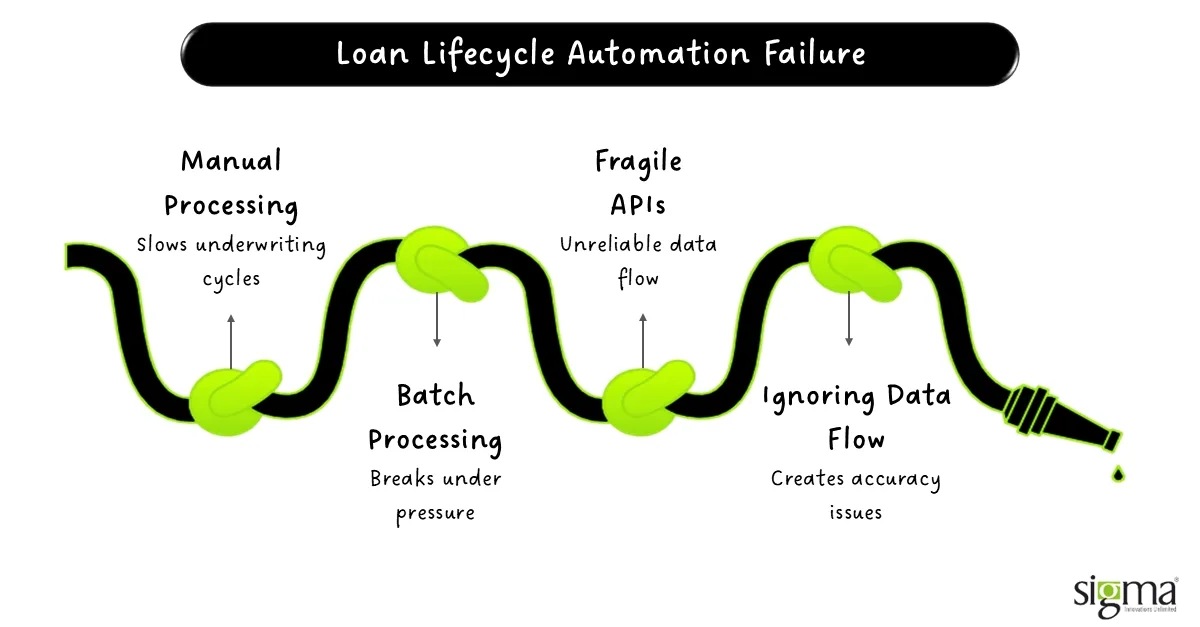
Current stats show that manual processing can stretch underwriting cycles to 72 hours, leading to a 20-25% borrower drop-off rate. When you rely on batch processing and fragile API bridges that break under pressure, you aren’t just slow, but you’re risky as well. Most lenders spend all their money making the “Apply Now” button look pretty, but they ignore the data flow across the loan lifecycle stages. This creates a mess of accuracy and speed in loan processing, making scaling up almost impossible without doubling your staff.
Also, read the blog – Simplifying Loan Journeys: What Modern Digital Lending Software Should Actually Do
The New Way to Lend by Moving Toward a Data Fabric
It’s time to change how we think about a loan. Instead of seeing it as a series of handoffs, we should see it as a lending lifecycle orchestration journey where data moves through “state transitions.” In this new mental model, we move away from silos and toward a scalable lending infrastructure. This is what we call a “Unified Lending Architecture.” It treats the entire process, from the first click to the final payment, as a continuous loop.
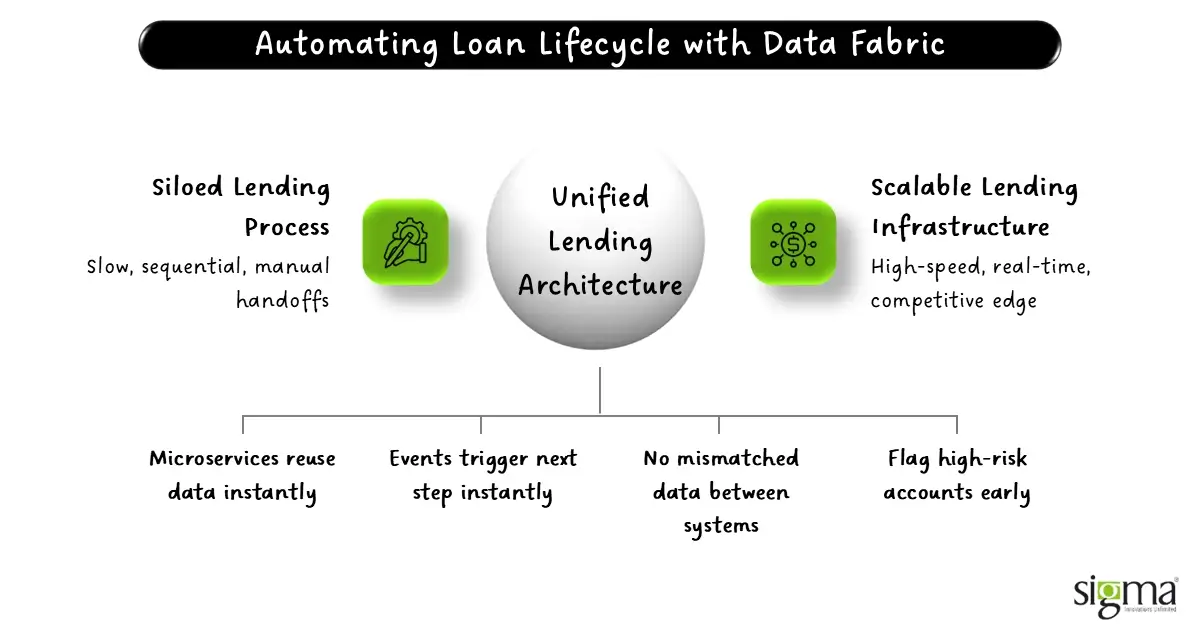
By using an automated lending platform built on microservices, you ensure that data captured once is reused everywhere. For example, when a borrower’s income is verified at the start, that information should instantly update the risk model and set the rules for the loan management system workflow without a human ever touching a keyboard. This is the power of lifecycle visibility and control.
- Real-time Transitions: Events trigger the next step instantly, eliminating the 24-hour “wait for the batch” delay.
- Single Source of Truth: No more mismatched data between your document management systems and your core ledger.
- AI-Driven Logic: Smart workflow automation engines can flag high-risk accounts before they ever miss a payment.
This shift turns lending from a slow, sequential process into a high-speed, real-time system. When your scalable Fintech infrastructure talks to itself in sub-seconds, you gain a massive competitive edge.
Also, read the blog: Engineering Seamless Lending Experiences: From Loan Eligibility to Disbursement in Seconds
Build Your Future on Better Code
The difference between a growing lender and a struggling one is how they handle their data. If you want accuracy and speed in loan processing, you can’t keep patching old systems with digital duct tape. You need an engineering-first approach that treats loan lifecycle management automation as the heartbeat of your business.
Turn your fragmented lending silos into a high-performance automated engine with Sigma’s Financial Software Development Services team.
Deconstructing the Workflow of a Modern Automated Lending Platform
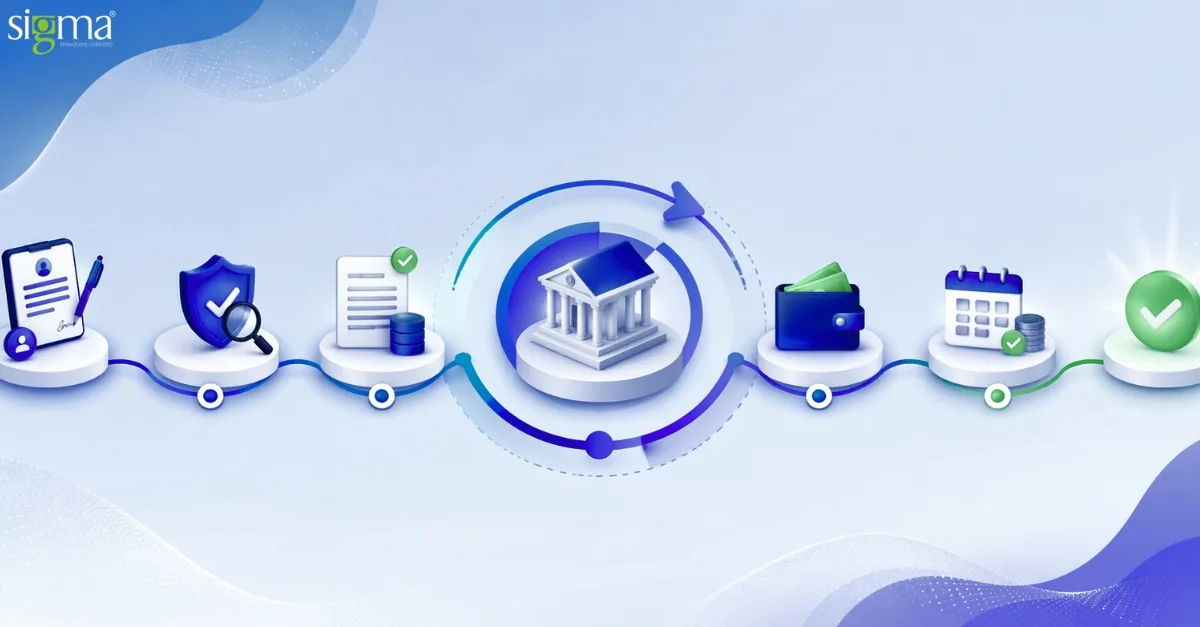
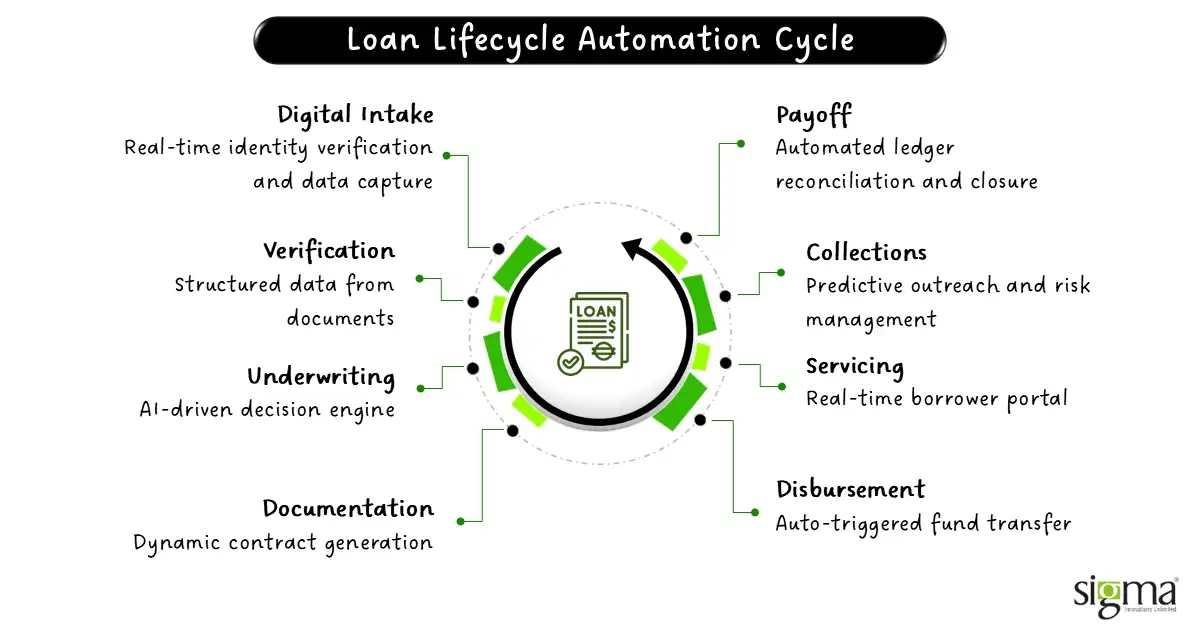
To build a truly scalable lending infrastructure, you have to stop looking at the loan process as a human checklist and start seeing it as a high-speed data pipeline. When you start with the loan lifecycle automation, you aren’t just replacing people with scripts, but also ensuring that every byte of borrower data flows perfectly from one stage to the next without hitting a wall. Let’s dive deeper into the perfect end-to-end lending automation.
Digital Intake: The Entry Point
Most lenders trip at the starting line with messy, manual KYC checks. Modern architecture uses an API-driven intake layer that triggers identity verification in real time. Instead of asking a borrower for the same info twice, the system creates a single source of truth. This ensures accuracy and speed in loan processing starts the second they hit “Apply.”
Verification: Turning Paper into Data
Manual document review is the ultimate momentum killer. By using OCR pipelines and document management systems, raw images of paystubs or IDs become structured data instantly. This validated info feeds directly into your engine. By the end of this year, automated verification is expected to reduce application errors by 30%, saving millions in rework.
Underwriting: The Decision Engine
Traditional underwriting relies on slow, human-led queues. A better way is a hybrid AI and rules engine that allows for “straight-through processing.” For low-risk files, the system decides in seconds. In the edge cases, it uses smart routing to alert a human. This turns decisioning into an event-driven trigger rather than a pile of digital paperwork.
Documentation: Closing the Gap
Once a loan is a “Yes,” the clock starts ticking. Using a template-driven engine integrated with e-sign tools, your digital lending software can generate dynamic contracts in seconds. Terms flow directly from the underwriting output, ensuring the contract matches the offer perfectly. This creates instant closing readiness and keeps the borrower engaged.
Disbursement: Moving the Money
There shouldn’t be a “lag” after a signature. By connecting your core banking systems directly to payment rail APIs (like ACH or wires), disbursement becomes an auto-triggered event. The moment the last signature is captured, the money moves. This status update also instantly moves the loan record into the servicing phase.
Servicing: Keeping the Connection
A disconnected loan management system is a nightmare for customer service. A unified servicing engine provides a real-time borrower portal where balances and transaction logs update in sub-seconds. This turns servicing into a data-driven engagement layer, rather than just a ledger that sends out monthly bills.
Collections: Proactive Recovery
Traditional collections are reactive; you wait for a missed payment. A smarter loan management system workflow uses AI to spot behavioral signals (like late logins) and triggers predictive outreach. This automated segmentation helps you manage risk before it becomes a loss, ensuring lifecycle visibility and control.
Payoff: Closing the Loop
The final stage is often handled manually, which is a waste of talent. Automated ledger reconciliation handles the final math and generates closure documents the moment the last cent is paid. This lifecycle completion event closes the loop, archiving the data and freeing up capital for the next borrower.
Technology Behind an Automated Lending Platform
A truly automated lending platform powered by scalable fintech infrastructure and workflow automation engines isn’t just a collection of apps, but a high-performance engine built on layers of smart tech. To achieve an automated loan lifecycle, your stack needs AI/ML for fraud detection and predictive risk, while RPA handles the grunt work of repetitive tasks. OCR and IDP act as the “eyes” of the system, turning messy documents into usable data.
However, the real secret sauce is the scalable Fintech infrastructure underneath. By using microservices and event streaming (like Kafka), your systems can “talk” to each other in real-time. This ensures that every event, like a signature or a payment, triggers the next action across the entire data flow across the loan lifecycle stages.
Remember, tools alone don’t create value, but the orchestration of those tools that builds a leader.
Why Automating Every Stage from Origination to Payoff Wins
When you fix the architectural rot, the business results are undeniable. Transitioning to a loan management system workflow that is fully integrated can lead to a 50% reduction in processing time. We are entering an era where same-day approvals and funding are the standard, not the exception.
By lowering the cost per loan and creating a bulletproof audit trail for compliance, you aren’t just saving money, but also gaining a massive competitive edge. This year, lenders won’t compete on interest rates alone because they will be competing on the speed and reliability of their execution. A scalable lending infrastructure ensures that your borrowers’ journey is frictionless, leading to higher retention and a stronger brand.
Read our success story – Streamlining Lending Operations with Intelligent Cheque Data Processing
The Big Decision: Build, Integrate, or Replace?
For many CTOs, the question isn’t if they should modernize, but how. If your current loan origination system software is blocking your growth, you have three paths.
- Building is best if you have a unique product that needs total customization.
- Integrating works for those who want to fix specific bottlenecks without a total overhaul.
- Replacing is often the only move when legacy systems become a liability.
At Sigma, we’ve seen that most lenders benefit from a “modular modernization” strategy. You don’t always have to rip everything out. Instead, focus on the lifecycle visibility and control gaps first. By prioritizing time-to-market and data continuity, you can modernize in stages without disrupting your current revenue.
Conclusion
The “black hole” of lending, those manual gaps between getting a lead and closing a loan, is no longer a cost of doing business. It is a sign of disconnected systems. At Sigma Infosolutions, we help you move past simple automation and toward a Unified Lending Architecture. By treating the loan lifecycle as a continuous, automated data stream, we eliminate the handoff tax and help you scale without the headache of increasing headcount.
The future of finance belongs to those who view their lending process as a single, immutable flow of information. It’s time to stop patching holes and start building a foundation that lasts.
Is your lending stack ready for the next decade?
Transform your lending architecture from a series of silos into a high-speed data fabric.
Frequently Asked Questions (FAQs)
1. How do I start implementing loan lifecycle automation in a digital lending software?
Start by identifying your “black holes“, the points where a human has to manually move data from one screen to another. Transitioning to a Unified Lending Architecture involves using APIs and microservices to ensure data captured during intake flows automatically into underwriting, servicing, and payoff.
2. What are the biggest challenges in loan lifecycle management today?
The main culprit is “Architectural Rot.” When your origination, document storage, and servicing tools don’t talk to each other, you face high latency, a 20-25% borrower drop-off rate, and increased operational costs.
3. How does document management work in modern lending workflows?
We move away from “folders” and toward OCR-driven pipelines. Modern systems instantly turn paystubs and IDs into structured data that feeds directly into risk models, reducing application errors by up to 30%.
4. What does a modern loan lifecycle architecture look like?
It’s an event-driven “data fabric.” Instead of batch processing, it uses microservices and real-time triggers. When a borrower signs a doc, the system instantly triggers disbursement and sets up the servicing ledger, no human intervention required.