The Complete Client Onboarding Checklist for Digital Lending Platforms in 2026: Steps, Tools, and Best Practices

Key Highlights:
- Sigma Infosolutions helps digital lenders design and implement structured onboarding processes that reduce deployment timelines, eliminate underwriting gaps, and establish clear operational accountability from day one.
- A well-executed lending platform onboarding process directly accelerates loan origination readiness, reduces compliance risk, and builds the foundation for long-term portfolio growth.
- Digital lending organizations that lack a defined onboarding checklist face higher rates of early platform abandonment, regulatory misalignment, and integration failures that erode lender profitability.
- Research consistently shows that lenders who complete a structured platform onboarding within the first 90 days achieve significantly faster time-to-first-loan and stronger repayment performance outcomes.
A poorly managed onboarding process is one of the most costly operational failures in digital lending. When non-banking financial companies (NBFCs) or NBFIs, alternative lenders, or fintech platforms attempt to deploy a loan origination system (LOS) or loan servicing system (LSS) without a defined implementation structure, the consequences include delayed go-lives, misaligned underwriting configurations, and compliance gaps that are difficult and expensive to correct post-launch.
A comprehensive client onboarding checklist tailored to digital lending is not a procedural formality; it is the operational framework that determines whether a lender’s platform investment produces returns on schedule or remains mired in configuration backlogs. This blog outlines the essential steps, tools, and best practices that digital lending implementation teams must follow to ensure consistent, audit-ready client onboarding in 2026.
Why Digital Lending Platform Onboarding Demands a Structured Approach
The period immediately following the signature of a digital lending platform contract is disproportionately influential in determining implementation success. Lenders form lasting judgments about a technology partner’s competence within the first two to four weeks of engagement. In digital lending specifically, this window is even more consequential because delays in platform configuration directly translate into delayed loan disbursements, missed borrower acquisition targets, and regulatory reporting failures.
Many lending organizations treat platform onboarding as a post-sales administrative hand-off rather than a structured technical and compliance function. This perspective produces fragmented data migration plans, undocumented underwriting logic, and unclear API integration timelines. When accountability is not established at the outset, implementation teams spend valuable cycles resolving ambiguities in credit policy configuration rather than progressing toward origination readiness.
The consequences of unstructured digital lending onboarding are measurable. A significant portion of lending platform implementations that exceed their go-live deadlines do so because pre-onboarding discovery was insufficient. Borrower data was not mapped to the correct loan product parameters, third-party bureau integrations were not tested in staging environments, and role-based approval workflows were not validated against the lender’s actual credit policy hierarchy. Addressing this systemic risk requires a documented, repeatable onboarding checklist framework tailored to the lending technology stack.
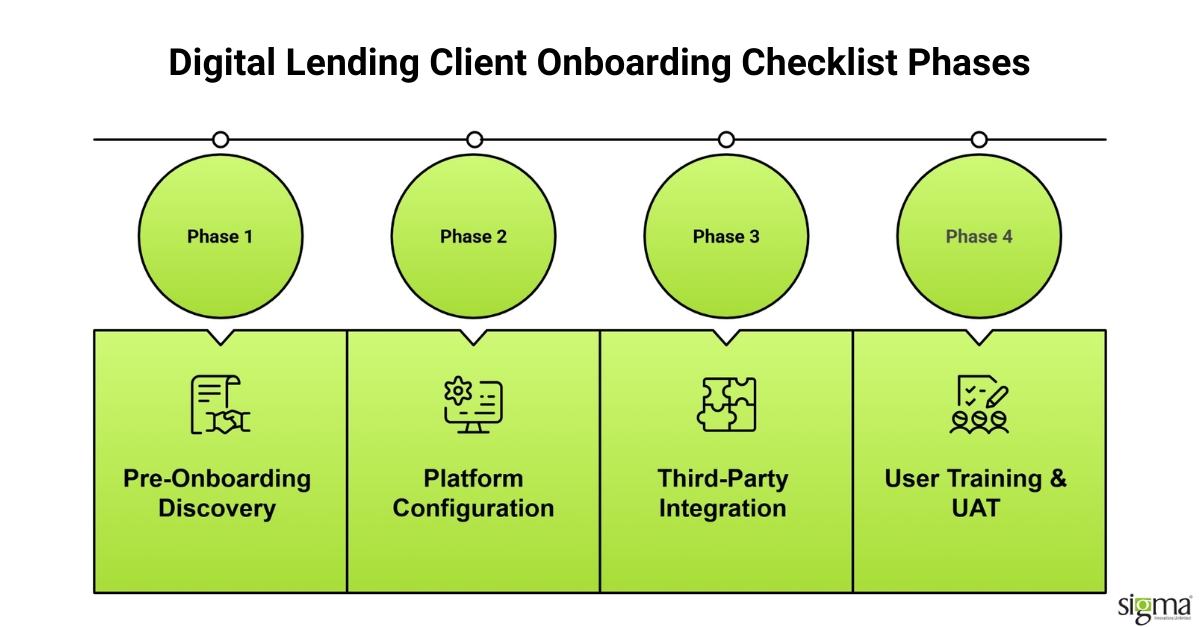
An effective client onboarding for the first loan for digital lending must cover five primary phases: pre-onboarding discovery, platform configuration and policy mapping, integration and compliance setup, user training and UAT, and go-live readiness. Each phase contains specific tasks, responsible owners, and defined completion criteria.
Phase 1: Pre-Onboarding Discovery and Loan Product Mapping
Before any platform configuration begins, implementation teams must conduct a structured discovery session to document the lender’s loan products, credit policies, borrower eligibility criteria, and regulatory obligations. This phase is the single most important determinant of implementation accuracy. Gaps identified here are far less expensive to resolve than those discovered during user acceptance testing (UAT).
Key tasks in this phase include reviewing the lender’s existing underwriting guidelines, mapping loan product parameters to the platform’s configuration schema, identifying all required third-party integrations such as credit bureaus and identity verification providers, and confirming jurisdiction-specific compliance requirements. A designated onboarding coordinator should own the discovery checklist and serve as the primary internal accountability point throughout the implementation.
Phase 2: Platform Configuration and Credit Policy Setup
This phase translates the discovery findings into functional platform settings. Loan origination workflows, decision logic rules, rate tables, fee structures, and document checklist configurations must all be built to reflect the lender’s actual operational requirements. In platforms built on microservices architecture, each configuration item should have a named owner, a target completion date, and a validation checkpoint. Configuration errors in credit policy logic are among the most common sources of post-launch audit findings, making structured review mandatory at this stage rather than optional.
Phase 3: Third-Party Integration and Compliance Configuration
For digital lenders, the breadth of third-party integrations required at launch is substantial. Credit bureau connections, fraud detection engines, e-signature providers, income verification services, and accounting system APIs must all be configured, credentialed, and tested in a staging environment before production deployment. Delays in this phase are a leading cause of schedule overruns in lending platform implementations.
Regulatory reporting integrations require particular attention. Lenders operating across multiple jurisdictions must ensure that their platform is configured to generate compliant reports in the correct format for each applicable authority. A checklist-based approach ensures that no integration or compliance configuration step is missed and that each item has a confirmed technical owner and a tested output before sign-off.
Phase 4: User Training and User Acceptance Testing
A digital lending platform delivers no value until the lender’s operational staff can use it accurately under real loan processing conditions. User training must be role-specific, covering loan officers, underwriters, compliance reviewers, and collections teams according to the permissions and workflows each role will interact with. Generic training programs that do not reflect the lender’s configured workflows produce high error rates in the early weeks post-launch.
UAT should be conducted using realistic loan scenarios drawn from the lender’s actual borrower profiles. Edge cases, such as applications that trigger escalation workflows or loans that require manual underwriter review, must be tested explicitly. Sign-off on UAT should require documented evidence that each critical workflow has been validated end-to-end.
Onboarding Tools That Support Digital Lending Implementation Consistency
The right onboarding tools reduce manual coordination effort and create a shared implementation workspace where both the lending client and the technology team can track configuration progress in real time. Tool selection for digital lending implementations must account for data sensitivity, regulatory access controls, and integration complexity. While tools support coordination, scalable lending operations ultimately depend on how well the underlying systems are engineered.
| Tool Category | Example Platforms | Primary Onboarding Function in Digital Lending |
| Project Management | Jira, Asana, Monday.com | Task tracking, milestone management, and implementation owner assignment |
| Loan Product Configuration | LOS/LSS Modules | End-to-end loan lifecycle setup, policy mapping, and workflow configuration |
| Integration Testing | Postman, Swagger, SoapUI | API validation for bureau, e-sign, and identity verification connections |
| Compliance Documentation | Confluence, SharePoint | Regulatory mapping, audit trail documentation, and policy version control |
| CRM and Handoff Management | Salesforce, HubSpot CRM | Sales-to-delivery handoff, client data capture, and onboarding status tracking |
The tool stack should be agreed upon during the pre-onboarding discovery phase. Introducing unfamiliar tools mid-implementation increases the cognitive load on both the lender’s team and the implementation partner. Where the lending client already has an established project management infrastructure, integration with that environment is preferred.
Learn more: How API-Driven Lending Platforms Enable Faster Go-To-Market
Best Practices: Onboarding Teams Must Standardize for Digital Lending Implementations
Best-practice onboarding frameworks for digital lending share a common characteristic: they are documented, tested against real loan product configurations, and continuously refined based on post-implementation reviews.
- Designate a single point of contact on both sides. Lending clients should never be uncertain about who to escalate integration blockers or credit policy clarification requests to. A named onboarding lead from both the technology provider and the lender’s operations team prevents communication delays that compound into schedule overruns.
- Set 30-60-90-day milestones aligned to lending readiness metrics. A phased milestone framework keeps implementation teams accountable and provides natural review points. The 30-day milestone should confirm platform configuration completion. The 60-day milestone should validate all integrations and compliance setups. The 90-day milestone should confirm UAT sign-off and go-live readiness.
- Document all credit policy decisions in writing. Verbal agreements about underwriting rules, rate approval hierarchies, or exception handling procedures create post-launch disputes and compliance audit risk. Every policy decision made during onboarding must be captured in a configuration log that both parties review and sign off on.
- Conduct a formal onboarding close-out review before production launch. This structured review session captures what was configured, what was deferred to a future release, and what the lender’s outstanding operational questions are. It transitions the engagement from implementation mode to production support and signals to the lending client that the platform is formally ready for live loan processing.
Read our success story: Automating Dealer Verification with Integrated CRM and Lending Workflows
How Sigma Infosolutions Structures Digital Lending Platform Onboarding
Digital lending onboarding is not just a configuration exercise—it is the point where platform architecture, credit strategy, and operational execution converge. Sigma Infosolutions approaches onboarding as an extension of its Digital Lending Solutions engineering capability, ensuring that lenders move from implementation to production with a system that is not only configured, but operationally resilient, integration-ready, and decision-enabled from day one.
Rather than treating onboarding as a linear checklist, Sigma structures it as a controlled deployment framework where every component, data, decisioning, integrations, and compliance—is aligned to real-world lending execution.
Engineering-Led Onboarding Framework for Digital Lending Solutions
- Architecture-First Onboarding Design
Sigma begins with a platform architecture alignment that ensures the onboarding process fits into a scalable, modular lending ecosystem.
- Aligns LOS/LMS capabilities with business growth plans
- Designs for multi-product, multi-tenant, and multi-jurisdiction readiness
- Establishes a foundation for future enhancements without rework
- Embedded Decisioning and Credit Logic Enablement
Onboarding is tightly coupled with how credit decisions are executed within the platform.
- Configures rule engines to reflect real-time underwriting logic
- Maps borrower data flows directly into decision pipelines
- Ensures approvals, declines, and risk scoring are system-driven, not manual
- API-First Integration Orchestration
Sigma’s Digital Lending Solutions are built around an API-first approach, making integration a core onboarding function,not a downstream task.
- Orchestrates bureau, KYC/KYB, fraud, and banking integrations within a unified workflow
- Enables parallel integration testing to reduce deployment timelines
- Ensures interoperability with core banking, ERP, and third-party ecosystems
- Compliance-by-Design Implementation
Instead of retrofitting compliance, Sigma embeds it into the onboarding architecture.
- Aligns data structures with regulatory reporting requirements from the outset
- Implements audit trails across workflows, approvals, and data access
- Ensures jurisdiction-specific compliance configurations are production-ready
- Operational Readiness and Workflow Activation
Sigma focuses on making the platform executable for business teams—not just technically complete.
- Activates role-based workflows across underwriting, operations, and servicing
- Validates end-to-end loan journeys under real usage scenarios
- Reduces dependency on manual interventions post go-live
- Controlled Go-Live and Scale Enablement
Onboarding concludes with a structured transition into live operations, minimizing risk during initial deployment.
- Phased rollout strategies to validate performance under real load
- Monitoring frameworks for early-stage issue detection
- Scalability planning to support increasing loan volumes without system strain
This approach ensures that Sigma’s Digital Lending Solutions are not just deployed—but fully operationalized, enabling lenders to move from onboarding to consistent loan origination, compliant operations, and scalable growth without disruption.
Conclusion
A structured client onboarding checklist is the operational foundation that determines whether a digital lending platform deployment delivers returns on schedule or accumulates costly configuration debt. The five-phase framework outlined in this blog provides lending organizations with a repeatable, audit-ready implementation structure that addresses the specific complexity of loan product configuration, third-party integration, and regulatory compliance setup. Organizations that invest in structured onboarding reduce go-live delays, minimize post-launch error rates, and accelerate their time-to-first-loan. Sigma Infosolutions provides the implementation rigor and platform depth that digital lenders require to onboard effectively and operate with confidence from the first day of production.
Organizations looking to operationalize structured onboarding frameworks can explore how Sigma Infosolutions delivers implementation-ready lending solutions combining configurable workflows, API-driven integrations, and audit-ready infrastructure.
Frequently Asked Questions
Q: What should a client onboarding checklist for a digital lending platform include?
A digital lending client onboarding checklist should include loan product discovery and policy mapping, platform configuration and workflow setup, third-party integration testing for bureaus and identity verification, role-specific user training, and UAT sign-off. Each item must have a named owner and a target completion date to ensure implementation accountability and reduce go-live delays.
Q: How long does digital lending platform onboarding typically take?
Digital lending platform onboarding typically ranges from four to twelve weeks, depending on the number of loan products, the complexity of third-party integrations, and the lender’s regulatory reporting obligations. Highly configurable platforms with pre-built bureau and identity verification integrations can significantly compress this timeline compared to custom-built implementations.
Q: What are the most common causes of digital lending onboarding failures?
The most common causes of digital lending onboarding failures include insufficient pre-onboarding discovery of credit policy requirements, late identification of third-party integration dependencies, lack of role-specific user training before UAT, and undocumented underwriting configuration decisions. Lenders that follow a structured checklist framework with defined milestones and named owners experience significantly fewer implementation delays.
Q: Which tools are most effective for managing a digital lending platform implementation?
Effective tools for digital lending implementations include Jira or Asana for milestone and task tracking, API testing platforms such as Postman for integration validation, Confluence or SharePoint for compliance documentation, and Salesforce for managing the sales-to-delivery hand-off.
Q: How does structured onboarding improve digital lending platform adoption and portfolio performance?
Structured onboarding improves platform adoption by ensuring that loan officers, underwriters, and compliance teams are trained on correctly configured workflows before processing live applications. Accurate configuration of credit policy logic, rate tables, and escalation rules directly reduces post-launch underwriting errors, audit findings, and loan processing delays that negatively affect portfolio performance and borrower experience.